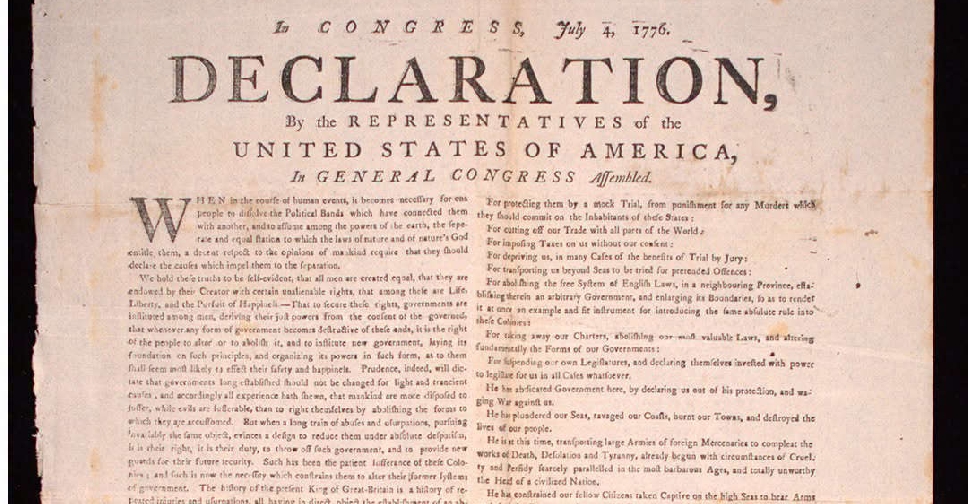
A "vanishingly rare" copy of the Declaration of Independence has been found in London, dug up in archives holding documents from the British capture of an American privateer ship in 1776, just as the United States celebrates its 250th anniversary.
The text, famous for its rallying cry for "life, liberty and the pursuit of happiness", had been listed in 18th century records as simply "another document" but in May a volunteer at Britain's National Archives took a closer look.
"Unearthing and handling such a significant historical document has been thrilling, particularly in this important anniversary year," said Michael Scurr, the volunteer who found it while working on a cataloguing project.
FIRST DECLARATION FOUND OUTSIDE THE US
News of the discovery was published on Friday, the day before the US celebrates its semiquincentennial Declaration of Independence from Britain, when millions of Americans will enjoy cookouts and display the Stars and Stripes outside their homes.
Back in 1776, July 4 was when the declaration was adopted by Congress, and as the revolutionary mood swept through the American colonies, supportive printers rushed to reproduce it and share as widely as they could the new country's founding document.
The one found in London was printed in Exeter, New Hampshire, in mid-July 1776 and is the 11th surviving copy of the so-called "Exeter Declarations", and the first to be found outside the United States.
Eleazer Johnson, captain of the Dalton ship, picked up a copy some months later that same year before he set sail across the Atlantic on a mission to try to seize British vessels, possibly hoping the text would inspire his crew to fight for the new country.
But on December 24, 1776, off the coast of Portugal, the Royal Navy captured the Dalton, and brought it and its contents back to Plymouth, southwest England.
The National Archives said the document is the only known copy of the declaration taken by military action.
Under the red tape of late 18th century England, all British captains had to present a captured ship's documents to the authorities in order to claim their share of the prize.
Given the British seized 3,600 ships during the American Revolutionary War, the National Archives offers a vast and fertile hunting ground for historians.
"Thanks to the bureaucratic processes of war ... we can present an unusually rich backstory that most surviving declarations do not have," Graham Moore, curator at the National Archives, said.

 Abu Dhabi invites public to name two 'giants' at Natural History Museum
 Swarms of moths in Australia lift hopes of recovery for endangered species
 NASA says new Roman telescope's lifespan could more than double, to 22 years
 Can sheep save the glaciers? Swiss scientists put wool to the test
 Ultra-white falcon fetches AED1.5 million at Abu Dhabi auction