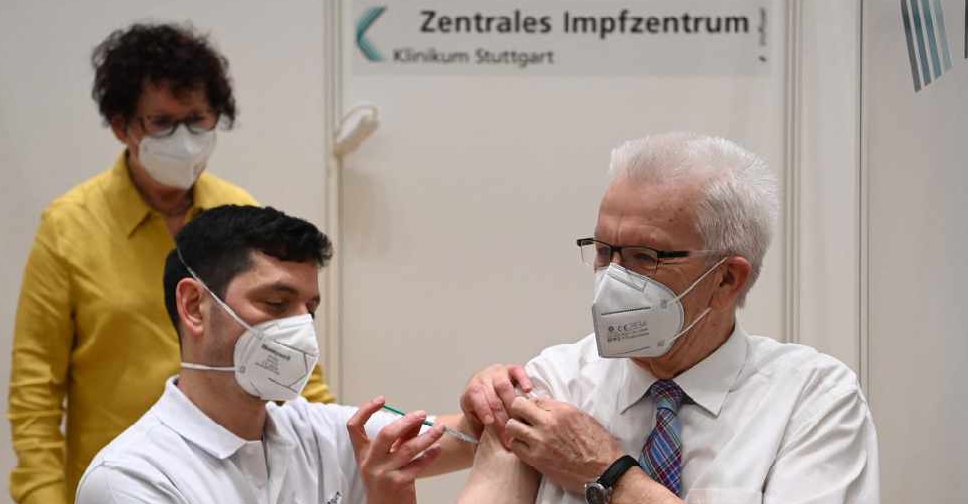
Nearly a dozen countries resumed use of AstraZeneca's COVID-19 shots on Friday.
It comes after EU and British regulators said the benefits outweighed any risks after reports of rare instances of blood clotting that temporarily halted inoculations.
The end of suspensions will kick off a test of public confidence, both in the shot and in drug regulators whose conclusions are under unprecedented scrutiny, as virus variants spread and the global death toll, now at nearly 2.7 million, rises.
Indonesia joined Germany, France and others in re-administering the shots after they suspended vaccinations on reports of around 30 cases of rare brain blood clots, after millions of injections, that sent scientists and governments scrambling to determine if there was a link.
The European Medicines Agency (EMA) came to what it called a clear conclusion that the vaccine's benefits in protecting people from coronavirus-related death or hospitalisation outweighed the possible risks.
Still, EMA said a link between rare events of blood clots in the brain and the shot could not be definitively ruled out and that it will continue its scrutiny, along with the British Medicines and Healthcare products Regulatory Agency (MHRA).
"This is a safe and effective vaccine," EMA director Emer Cooke told a briefing on Thursday. "If it were me, I would be vaccinated tomorrow."
The EMA said it would update its guidance on the vaccine to include an explanation for patients about the potential risks and information for healthcare professionals, to help people recognise instances when they may need to seek medical assistance following a vaccination.
After the EMA move, others also sought to reinforce confidence in AstraZeneca's vaccine, which is seen globally as an important asset due to its relatively easy storage and transport requirements and inexpensive price, compared to mRNA vaccines made by Pfizer and Moderna.
Oxford University is partnered with AstraZeneca on the vaccine.
Germany resumed administering the AstraZeneca vaccine from Friday morning, while French Prime Minister Jean Castex said he would seek to promote a similar resumption in his country by getting the shot himself on Friday.
Italian Prime Minister Mario Draghi said Italy would follow suit, echoing sentiments from Cyprus, Latvia and Lithuania.
Spain will resume inoculations from Wednesday. Canada also gave its backing to the vaccine.
Britain's MHRA is investigating five cases of the rare brain blood clot that had been reported out of 11 million shots administered in the UK.
It said it would investigate reports of clots in the cerebral veins (sinus vein thrombosis, or CSVT) occurring together with lowered platelets soon after vaccination.
But the agency said use of the vaccine should continue and one official said Britain's rollout would likely not stop even if a link was proved.
The drugmaker's own review covering more than 17 million people who have received its shot in the EU and Britain found no evidence of increased risk of blood clots.
The World Health Organisation, which this week also reaffirmed its support for the shot that remains a centrepiece of its COVAX vaccine sharing programme, plans on Friday to give an update on its vaccine advisory committee's own review.


 Trump says ISIS second-in-command killed by US and Nigerian forces
 Tens of thousands march in London in separate protests
 Eight injured as car rams into pedestrians in Italian city of Modena
 At least 8 dead, 32 injured in train collision that sparks bus fire in Thailand
 Iraqi PM pledges to strengthen Arab, international relations