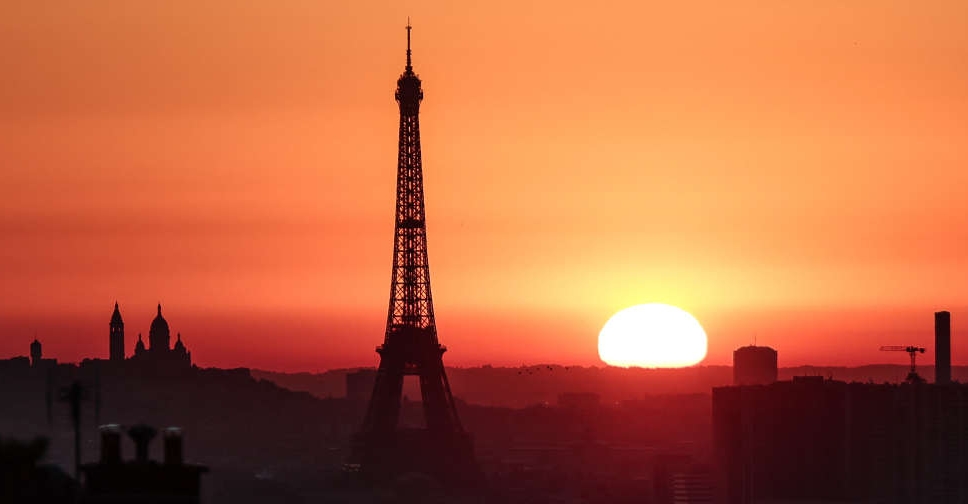
More than a thousand schools were closed in France on Tuesday and the top floor of the Eiffel Tower was shut to tourists as a severe heatwave continued to grip Europe, triggering health alerts across the region.
The Mediterranean Sea was up to 6 degrees Celsius warmer than usual for the time of year, hitting a record of as much as 30 C in Spain's Balearic Sea as a heat dome trapped hot air above Europe, the country's Aemet weather forecaster said.
Europe is the world's fastest-warming continent, heating up at twice the global average, according to the EU's Copernicus Climate Change Service, making extreme heatwaves occur earlier in the year, and persist into later months.
In France, the heat was set to peak on Tuesday, reaching 40-41 C in some areas and 36-39 C in most others, weather forecaster Meteo France said. Sixteen departments will be on the highest level of alert from noon, with 68 on the second highest.
Some 1,350 schools will be fully or partially closed due to the heat, up significantly from around 200 on Monday, the Education Ministry said. The top floor of the Eiffel Tower will be closed on Tuesday and Wednesday, with visitors advised to drink plenty of water.
The extreme heat also raised the risk of field fires as farmers in France, the European Union's biggest grain producer, start harvesting this year's crop.
Some farmers were working through the night to avoid harvesting during peak temperatures in the afternoon. In the Indre region of central France, which has seen a spate of field fires since late June, authorities banned field work between 2:00 pm and 6:00 pm.
HEALTH ALERTS
The intense heat could harm biodiversity, some experts said.
"In the past we have seen impacts like mass mortalities of invertebrate species, die-offs of seagrass beds and disease outbreaks in mussel farms. It's likely that we'll see similar impacts from this event," said scientist Kathryn Smith of the Marine Biological Association of the United Kingdom.
Health alerts have been issued across Europe, with residents and tourists alike seeking ways to keep cool.
Extreme heat kills up to 480,000 people annually around the world, according to Swiss Re, which notes this exceeds the combined toll from floods, earthquakes and hurricanes.
In a retirement home in Grimbergen, Belgium, residents passed a ball to each other in a paddling pool.
"To me it's a great activity," said Marie-Jeanne Olbrechts, one of the residents.
The DGG association for geriatric care in Germany said most regions of the country were not adequately prepared for a heatwave.
"If they were, they could prevent tens of thousands of deaths in the future," said Clemens Becker, author of a study conducted on behalf of the DGG.
Scientists say greenhouse gas emissions from burning fossil fuels are a key cause of climate change, with deforestation and industrial practices being other contributing factors. Last year was the planet's hottest on record.

 Trump says talks with Iran could resume soon, as US blockades Iranian ports
 Four dead after Turkey's second school shooting in two days
 India Vedanta power plant blast kills at least 17
 US hosts Lebanese and Israeli envoys as Israel presses war on Hezbollah
 US, Iran may resume talks this week despite port blockade