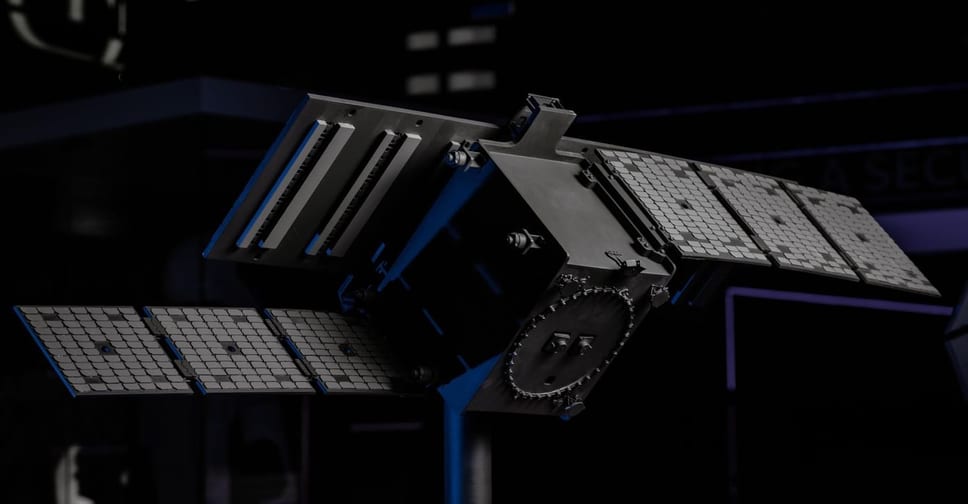
The UAE Space Agency has completed its critical design review for its first satellite under the National Synthetic Aperture Radar (SAR) programme.
The CDR is the final major design review prior to the manufacture of flight hardware, where it was assessed for its satellite design and performance against mission requirements, including verification and validation plans, interface controls, mission assurance, risk assessments, and readiness.
Named Sirb-1, the satellite is designed to deliver precise, all-weather, day-and-night Earth imaging.
Unlike optical satellites, SAR satellites transmit their own radar signals, enabling them to capture imagery of the Earth’s surface by day and night and through cloud, haze, and dust.
This capability supports a broad range of applications, including monitoring for environmental, agricultural and maritime needs, infrastructure management, and disaster response.
The programme also aims to build national expertise in SAR technology, developing intellectual property and strengthening the UAE’s domestic supply chain.
The review was carried out in partnership with the EDGE group through its space entity FADA.
The programme will now proceed to the manufacturing, assembly, integration, and testing phase ahead of its targeted launch in 2028.
"Beyond this milestone, our focus is on building lasting industrial capabilities, expanding opportunities for UAE companies and establishing a national space ecosystem that can compete globally," said Salem Butti Al Qubaisi, Director General of the UAE Space Agency.
"Our mission is strengthening sovereign control over space systems and ensuring the UAE’s global standing in Earth observation systems," added Waleid Al Mesmari, President of Advanced Sensing at EDGE.

 UAE lifts visa restrictions on Ugandan nationals
 Dr Gargash highlights UAE's 'constructive role' in Russia-Ukraine-US trilateral talks
 Dubai to reward residents with AED 2,500 for naming community parks
 ADNOC L&S vessel sustains damage following attack