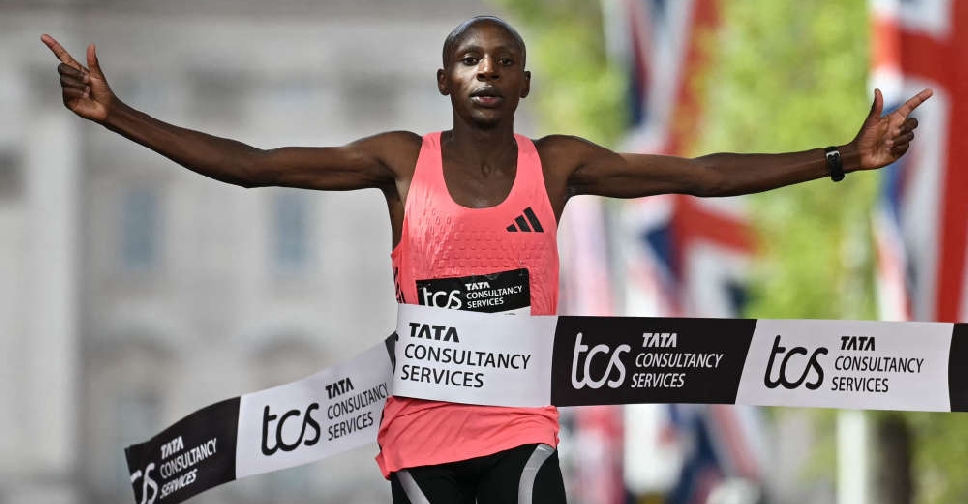
New marathon world record holder Sabastian Sawe brushed aside suggestions his Adidas "super shoes" amounted to "mechanical doping" on Monday as he basked in the glow of becoming the first man to break the two-hour barrier in an official race.
The 31-year-old Kenyan shattered one of athletics' most elusive barriers in storming to victory at the London Marathon in one hour 59 minutes and 30 seconds.
Running in Adidas's 97 gramme Adizero Adios Pro Evo 3, he also obliterated the world record of 2:00.35, set by the late Kelvin Kiptum in 2023.
"The shoe is very nice, very light, comfortable, and so supportive, and it's pushing forward," he said. "And the big difference is it's so light and very comfortable."
Sawe's run was the most dramatic marker yet of a technological arms race that has transformed distance running over the past decade but he was unmoved when asked if criticism around the shoes annoyed him.
"Absolutely no, because the shoe was approved," he said. "And I think there were no doubt about it. So I have no doubt about it."
The women's race offered its own striking parallel as Tigst Assefa broke her own women's-only world record (without male pacemakers) to retain her London title -- doing so in the same Adidas model worn by Sawe.
"For the future, I would love to get the all‑time world record for women's marathon," Assefa said.
"And in terms of the shoes, I'll speak to my coach and I'll speak to my shoe company and hope that they can continue to give me the shoes that are going to allow me to run fast."
Assefa clocked 2:15.41 on Sunday.
Fellow Kenyan Ruth Chepng'etich set the world record in a mixed race when she became the first woman to break both the 2:11:00 and 2:10:00 barriers, clocking 2:09.56 in Chicago in 2024.
Although she was banned three years for doping in October 2025, her achievements pre-dating her March 2025 sample stand, leaving fans confused about what they should be believing in.
NATURAL CEILING
The two-hour men's marathon was once treated as a natural physiological ceiling, with athletes moving towards it in small increments. This century, records had fallen by seconds until the past nine years when they have plummeted by minutes.
The turning-point came with the arrival of Nike's high‑stack shoes built around ultra‑responsive foams and stiff carbon elements designed to improve running economy.
Independent studies showed gains in running economy of 2 to 4% - trivial on paper, but monumental over 42.195 kilometres, where seconds usually decide medals and minutes are the difference between eras, and the latest generation of shoes have made those 2016 models obsolete.
World Athletics tried to regulate the revolution in 2020, capping sole thickness and limiting plates rather than banning the technology outright. The aim was compromise: allow innovation, but stop shoes becoming mechanical aids, and rival shoe companies immediately hurried to get their own versions to the market.
Sunday's race suggested that compromise has still left the sport in a very different place.
Almost lost amid Sawe's historic win was the fact that Ethiopia's Yomif Kejelcha became distance running's "second man on the moon" as he finished second in 1:59:41 on his marathon debut.
A barrier that only a few years ago many believed would never fall was beaten twice in the space of 11 seconds.
Defenders of the super-shoe era point out that innovation has always shaped athletics as cinder tracks were replaced by synthetic surfaces and lighter, responsive racing spikes helped modern athletes rip past some long-standing records.
Critics counter that shoes now operate too close to the body's mechanics, storing and returning energy in ways previous generations never had access to and say historical context has gone and the ability to compare performances across generations has been wiped out.
On a spring morning in London, the goalposts moved further than almost anybody thought possible, undoubtedly carried forward by legs, lungs, talent, training and belief, but also by foam, carbon and design.

 UAE, Saudi Arabia set for Gulf Cup final showdown
 Djokovic wins China Open as de Minaur retires injured
 Alcaraz sinks Lehecka to retain Japan Open crown
 McIlroy set for Dubai return at DP World Tour Championship in November
 Kaur steps down as India women's team captain