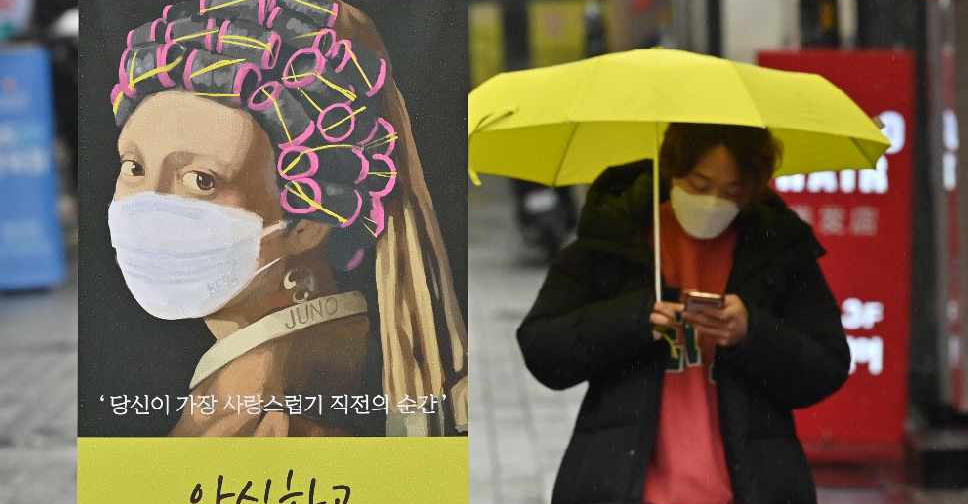
South Korean authorities were scrambling on Wednesday to contain coronavirus outbreaks centred around some schools as the country reported a jump in infections.
A total of 297 COVID-19 cases had been traced to six churches and mission schools run by a Christian organisation, senior health official Yoon Tae-ho told a briefing.
More than 100 cases were confirmed overnight among people linked to a church and its mission school in Gwangju, about 270 kms south of Seoul, officials said. Another 171 cases had been linked to an affiliated school in the city of Daejeon since January 17.
The Korea Disease Control and Prevention Agency (KDCA) said the Daejeon mission school outbreak appeared to have been spreading for some time before it was detected.
The Christian organisation responsible for the facilities, International Mission, was ordered to test everyone linked to 32 of its 40 schools and churches around the country.
The group apologised for not taking early measures to prevent the outbreak. It said that while some infected students may have been asymptomatic it had also failed to require students with cold-like symptoms to get tested.
"We deeply apologise for not responding earlier and for thinking the students could have had a cold when a student first developed fever," it said in a statement.
The organisation said it would submit a full list of students and staff in its schools nationwide.
Prime Minister Chung Sye-kyun called on people affiliated with the affected facilities to get tested.
"The key is speed. I call on the authorities and local governments to make all-out efforts to identify related facilities and prevent further transmission," Chung told a government briefing.
The KDCA reported 559 new cases as of midnight on Tuesday, up from 354 a day before, bringing the national tally to 76,429 infections with 1,378 deaths.
South Korea had managed to keep the virus under control thanks to aggressive testing and contact-tracing, but a third wave that broke out late last year has proven more difficult to contain.
The KDCA has said 45.4 per cent of infections in the country over the past year were caused by cluster infections emerging from specific close-knit groups. Religious facilities were the main source of such clusters.


 Strong earthquake strikes central Peru
 Overloaded boat capsizes in Nigeria, at least 40 bodies recovered
 Bangladesh elects ruling party veteran Alamgir as president
 Russian strikes kill 16 in Ukraine's Kyiv
 Prince Harry and Meghan to move back to Britain