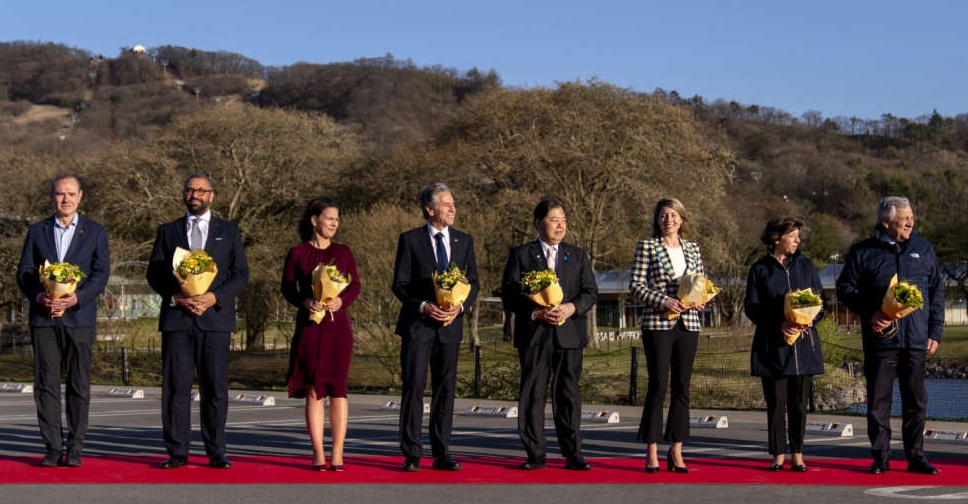
The Group of Seven nations on Sunday set big new collective targets for solar power and offshore wind capacity, agreeing to speed up renewable energy development and move toward a quicker phase-out of fossil fuels.
But they stopped short of endorsing a 2030 deadline for phasing out coal that Canada and other members had pushed for, and left the door open for continued investment in gas, saying that sector could help address potential energy shortfalls.
"In the midst of an unprecedented energy crisis, it's important to come up with measures to tackle climate change and promote energy security at the same time," Japanese industry minister Yasutoshi Nishimura told a news conference.
"While acknowledging that there are diverse pathways to achieve carbon neutral, we agreed on the importance of aiming for a common goal toward 2050," he said.
G7 ministers finish two days of meetings on climate, energy and environmental policy in the northern Japanese city of Sapporo on Sunday. Renewable fuel sources and energy security have taken on a new urgency following Russia's invasion of Ukraine.
"Initially people thought that climate action and action on energy security potentially were in conflict. But discussions which we had and which are reflected in the communique are that they actually work together," said Jonathan Wilkinson, Canada's minister of natural resources.
In their communique, the members pledged to collectively increase offshore wind capacity by 150 gigawatts by 2030 and solar capacity to more than 1 terawatt.
They agreed to accelerate "the phase-out of unabated fossil fuels" - the burning of fossil fuels without using technology to capture the resulting C02 emissions - to achieve net zero in energy systems by 2050 at the latest.
On coal, the countries agreed to prioritise "concrete and timely steps" towards accelerating the phase-out of "domestic, unabated coal power generation", as a part of a commitment last year to achieve at least a "predominantly" decarbonised power sector by 2035.
Canada was clear that unabated coal-fired power should be phased out by 2030, and Ottawa, Britain and some other G7 members committed to that date, Canada's Wilkinson told Reuters.
"Others are still trying to figure out how they could get there within their relevant timeframe," Wilkinson said.
"We are trying to find ways (for) some who are more coal-dependent than others to find technical pathways how to do that," he said.
'HUGE STATEMENTS'
"The solar and wind commitments are huge statements to the importance that they will rely on the energy superpowers of solar and wind in order to phase out fossil fuels," said Dave Jones, who is head of data insights at energy think tank Ember.
"Hopefully this will provide a challenge to Japan, for which offshore wind is the missing part of the jigsaw that could see its power sector decarbonise much quicker than it thought possible."
Host country Japan, which depends on imports for nearly all its energy needs, wants to keep liquefied natural gas (LNG) as a transition fuel for at least 10 to 15 years.
The G7 members said investment in the gas sector "can be appropriate" to address potential market shortfalls provoked by the crisis in Ukraine, if implemented in a manner consistent with climate objectives.
They targeted 2040 for reducing additional plastic pollution to zero, bringing the target forward by a decade.


 Strong earthquake strikes central Peru
 Overloaded boat capsizes in Nigeria, at least 40 bodies recovered
 Bangladesh elects ruling party veteran Alamgir as president
 Russian strikes kill 16 in Ukraine's Kyiv
 Prince Harry and Meghan to move back to Britain