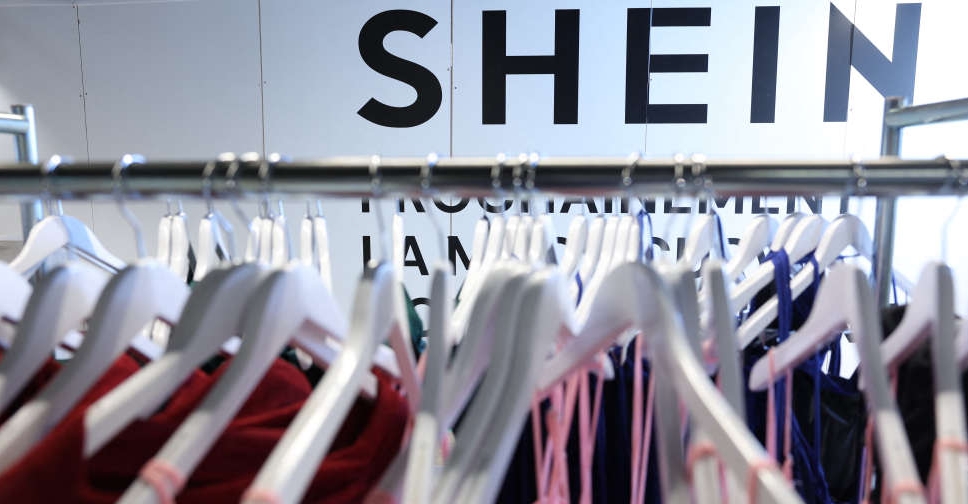
Shein aims to raise up to $1.8 billion in a Hong Kong IPO that values the fast-fashion retailer roughly 70 per cent below its private-market peak four years ago, with a slower growth outlook set to weigh on investor demand.
The long-awaited Hong Kong IPO comes after Shein, known for selling $5 dresses and $10 jeans to shoppers in about 160 countries, scrapped plans to list in New York and London over the past four years.
Shein on Monday launched the process to sell 280 million shares at between HK$47.60 and HK$49.50 per share, the company's filings showed, raising up to HK$13.86 billion ($1.77 billion) and valuing it at close to $27 billion at the top of that range.
The marked decline in valuation comes as tariffs, intensifying competition and rising costs cloud Shein's outlook.
Shein was valued at $64 billion in 2023 and April 2024. Reuters last week exclusively reported the IPO was set to value the company at around a quarter of the $100 billion it was worth in 2022.
Even after it sharply cut the valuation, analysts said the growing headwinds in its core markets of the United States and Europe would weigh on the company's fundraising.
"The drop in Shein's valuation largely reflects the change in prospects for the company from, say, two to three years ago when its IPO was first mooted," said Lorraine Tan, Singapore-based director of equity research for Asia at Morningstar.
"We believe interest in Shein by global investors has probably cooled as a result, leading to the reduced listing price."
At $27 billion, Shein is valued at around 0.7 times forecast sales, expensive than European rival Zalando's 0.4 times, but cheaper than H&M and Inditex, which trade at around 1.1 times and 4.0 times, respectively.
"Public investors are no longer paying for hyper-growth," said Winston Ma, an adjunct professor at New York University School of Law and former head of North America for China's sovereign wealth fund CIC.
"They are underwriting a mature cross-border platform that must now defend its profit margins against trade tariffs, higher compliance costs, and regulatory scrutiny in both the US and China."
GROWTH SLOWS SHARPLY
The China-founded, Singapore-headquartered company will announce the final IPO price on August 31 and start trading on September 1.
Cornerstone investors led by existing shareholders Boyu, Tiger Global and General Atlantic have subscribed for about $383 million worth of Shein shares, the prospectus showed. Tencent, Greenwoods, Taikang Life and UBS Asset Management will also take stock.
Shein said it would use about 80 per cent of the cash raised in the IPO to improve its technology and increase its brand and global presence.
It has agreed to pay up to about $3.5 billion in cash to certain investors who bought special shares in earlier private funding rounds, according to the prospectus.
The shares sold in the IPO will have one-tenth the voting rights of the shares held by the company's founders. Co-founders Sky Yangtian Xu, Maggie Gu, Molly Miao and Tony Ren will control 90 per cent of Shein's voting rights, the prospectus showed.
Slowing revenue growth and weaker core earnings are weighing on Shein's business, while shrinking margins have also raised concerns its expansion is running into headwinds from higher trade costs, tighter regulatory scrutiny and intensifying competition across global e-commerce.
Shein said in the prospectus its first-half 2026 revenue growth is expected to be broadly in line with the 1.1 per cent growth posted in the first quarter, while its operating margin is expected to be slightly lower than the first-quarter level.
The company said this is due to new European import charges, pricing pressure and weaker demand in the Middle East linked to the Iran war.
"I'm not that positive on the Shein IPO. Their growth has slowed down a lot already," Dickie Wong, executive director of research at uSMART Securities in Hong Kong.
"I expect the subscription response to be just average. While the valuation has come down significantly, I would not recommend subscribing at this stage given the slower growth outlook and regulatory pressures."
SLIDING VALUATION
Shein swung to a $99 million quarterly loss after the US removed an import duty exemption on small packages, and a $328 million fair-value charge on convertible redeemable preferred shares following an accounting change.
The de minimis rule had allowed packages worth less than $800 ordered online from China to enter the US duty free. Shein previously said Chinese-origin products sold by it or through its marketplace and shipped to the US are now subject to tax rates ranging from 10 per cent to 87.5 per cent.
In its prospectus, Shein said it faces a "significantly higher level of duties and taxes" in the US which directly triggered a 14.3 per cent drop in US revenues during the first quarter this year.
The company said it has set aside about $80 million at end-March for ongoing legal and regulatory cases. These include a US Federal Trade Commission investigation that could result in significant payments, an EU Digital Services Act investigation and data privacy cases in France and Ireland.
Shein's purchase of US clothing brand Everlane in May for $80 million is now facing a national security review by the Committee on Foreign Investment in the United States (CFIUS), according to a person familiar with the matter.
Shein did not immediately respond to a request for comment from Reuters.
Shein's IPO is the largest new share sale in Hong Kong in 2026, surpassing autonomous driving firm Momenta Global's $751 million offering in July.

 Over 7,000 new Indian companies join Dubai Chamber of Commerce
 UAE-Russia services and investment agreement takes effect
 UAE backs closer tourism cooperation at BRICS meeting
 Abu Dhabi DoE expands tech partnerships during US visit
 US, Canada fail to reach a tariff deal, deepen trade war