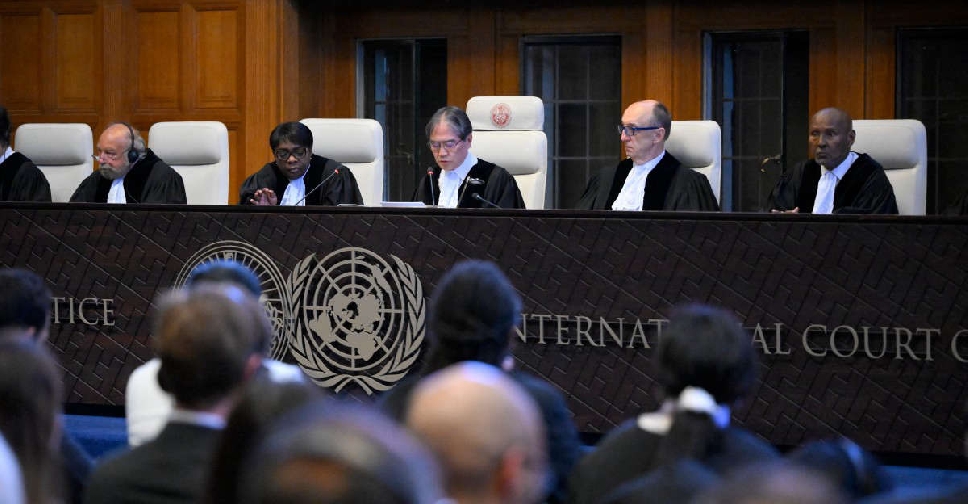
The United Nations' highest court on Wednesday said countries must address the "urgent and existential threat" of climate change by cooperating to curb emissions, as it delivered an opinion set to determine future environmental litigation.
The opinion by the International Court of Justice (ICJ), also known as the World Court, was immediately welcomed by environmental groups. Legal experts said it was a victory for small island and low-lying states that had asked the court to clarify states' responsibilities.
"Climate change treaties establish stringent obligations on states," judge Yuji Iwasawa said, adding that failing to comply with them was a breach of international law.
"States must cooperate to achieve concrete emission reduction targets," Iwasawa said, as he read out the court's advisory opinion.
He said that national climate plans must be of the highest ambition and collectively maintain standards to meet the aims of the 2015 Paris Agreement that include attempting to keep global warming below 1.5 degrees Celsius (2.7 Fahrenheit).
Under international law, he said: "The human right to a clean, healthy and sustainable environment is essential for the enjoyment of other human rights."
Earlier, as he started reading the court's opinion, judge Iwasawa laid out the cause of the problem and the need for a collective response.
"Greenhouse gas emissions are unequivocally caused by human activities which are not territorially limited," he said.
Although it is non-binding, the deliberation of the 15 judges of the ICJ in The Hague carries legal and political weight and future climate cases would be unable to ignore it, legal experts say.
"This is the start of a new era of climate accountability at a global level," said Danilo Garrido, legal counsel for Greenpeace.
The two questions the UN General Assembly asked the judges to consider were: what are countries’ obligations under international law to protect the climate from greenhouse gas emissions; and what are the legal consequences for countries that harm the climate system?
In two weeks of hearings last December at the ICJ, wealthy countries of the Global North told the judges that existing climate treaties, including the 2015 Paris Agreement, which are largely non-binding, should be the basis for deciding their responsibilities.
Developing nations and small island states argued for stronger measures, in some cases legally binding, to curb emissions and for the biggest emitters of climate-warming greenhouse gases to provide financial aid.
Ahead of the ruling, supporters of climate action gathered outside the ICJ, chanting: "What do we want? Climate justice! When do we want it? Now!"
In 2015, at the conclusion of UN talks in Paris, more than 190 countries committed to pursue efforts to limit global warming to 1.5 C (2.7 degrees Fahrenheit).
The agreement has failed to curb the growth of global greenhouse gas emissions.
Late last year, in the most recent "Emissions Gap Report," which takes stock of countries' promises to tackle climate change compared with what is needed, the UN said that current climate policies will result in global warming of more than 3 C (5.4 F) above pre-industrial levels by 2100.
As campaigners seek to hold companies and governments to account, climate‑related litigation has intensified, with nearly 3,000 cases filed across almost 60 countries, according to June figures from London's Grantham Research Institute on Climate Change and the Environment.
So far, the results have been mixed.
A German court in May threw out a case between a Peruvian farmer and German energy giant RWE, but his lawyers and environmentalists said the case, which dragged on for a decade, was still a victory for climate cases that could spur similar lawsuits.
Earlier this month, the Inter-American Court of Human Rights, which holds jurisdiction over 20 Latin American and Caribbean countries, said in another advisory opinion its members must cooperate to tackle climate change.
Campaigners say Wednesday's court opinion should be a turning point, even if the ruling itself is advisory.
The ruling could also make it easier for states to hold other states to account over climate issues. Although it is theoretically possible to ignore an ICJ ruling, lawyers say countries are typically reluctant to do so.

 Israel, Lebanon to begin 10-day ceasefire
 Myanmar cuts ex-leader Aung San Suu Kyi's sentence, frees former president
 US military: ready to strike Iran's power plants, energy industry if ordered
 GCC parliamentary speakers stress unified stance against Iranian attacks
 Countries to discuss Hormuz mission for when conflict ends