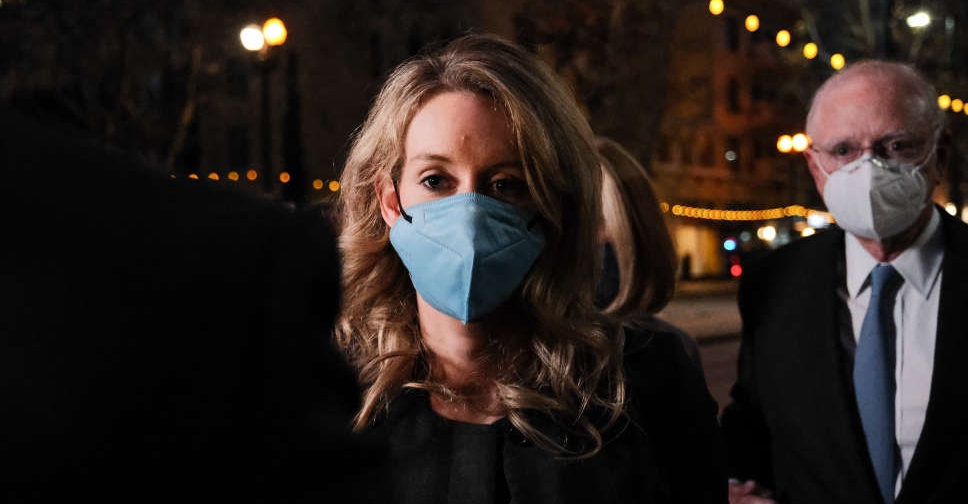
A US jury on Monday found Theranos founder Elizabeth Holmes guilty of defrauding investors in the blood testing startup, convicting her on four of 11 counts.
Holmes was convicted of investor fraud and conspiracy, but acquitted on three counts of defrauding patients who paid for tests from Theranos, and a related conspiracy charge. The jury could not reach a decision on three counts related to other, individual investors.
Holmes appeared poised after the verdict was read. A sentencing date was not immediately set.
Prosecutors said Holmes, 37, swindled private investors between 2010 and 2015 by convincing them that Theranos' small machines could run a range of tests on just a single drop of blood from a finger prick.
Holmes rose to Silicon Valley fame after founding Theranos in 2003 at age 19. She attracted both high-profile wealthy investors including media mogul Rupert Murdoch and high-profile board members. Her net worth was estimated at $4.5 billion by Forbes in 2015.
She faces up to 80 years in prison when sentenced by US District Judge Edward Davila but will likely get a much lower sentence.
Holmes was also charged with misleading patients about the tests' accuracy but was acquitted of those charges.
Holmes is likely to appeal, but her attorneys and a spokesperson for prosecutors did not respond to requests for comment on Monday. The jury's verdict came after seven days of deliberations.
The case shed light on Theranos' failed endeavor to revolutionise lab testing. The company secretly relied on conventional machines manufactured by Siemens to run patients' tests, prosecutors said.
Theranos collapsed after the Wall Street Journal published a series of articles that suggested its devices were flawed and inaccurate. Holmes was indicted in 2018 alongside Theranos' former chief operating officer Ramesh "Sunny" Balwani.
Balwani also has pleaded not guilty and will be tried at a later date.
During the trial in San Jose, California, which began in September, jurors heard testimony from former Theranos employees who said they left the company after witnessing problems with its technology.
Former patients testified that they would not have used Theranos' tests if they had known the tests were flawed.
Holmes was acquitted on charges of defrauding patients. Her attorneys had argued there was no statistical evidence showing errors were happening at such a high rate that Holmes knew the tests were inaccurate.
Investors testified that Holmes made a range of misleading claims about Theranos, including that its machines were being used in the field by the US military.
Prosecutors said had Holmes been truthful with investors and patients, the venture never would have attracted critical funding and revenue.
"She chose fraud over business failure. She chose to be dishonest," Assistant U.S. Attorney Jeff Schenk said at the start of closing arguments. "That choice was not only callous, it was criminal."
Testifying in her own defense at trial, Holmes said she never meant to deceive anyone and said Theranos' lab directors were in charge of test quality. In closing arguments, defense attorney Kevin Downey said the evidence did not show Holmes was motivated by a cash crunch at Theranos, but rather thought she was "building a technology that would change the world".
"You know that at the first sign of trouble, crooks cash out," but Holmes stayed, Downey said. "She went down with that ship when it went down."


 Powerful winter storm shuts schools, disrupts travel across US Northeast
 Mexican military kills cartel boss 'El Mencho' in US-backed raid
 Afghanistan says Pakistan strikes kill and injure dozens
 Police officer killed, dozens injured in bomb explosions in Ukraine's Lviv
 Trump pivots to new 15% global tariff after Supreme Court setback