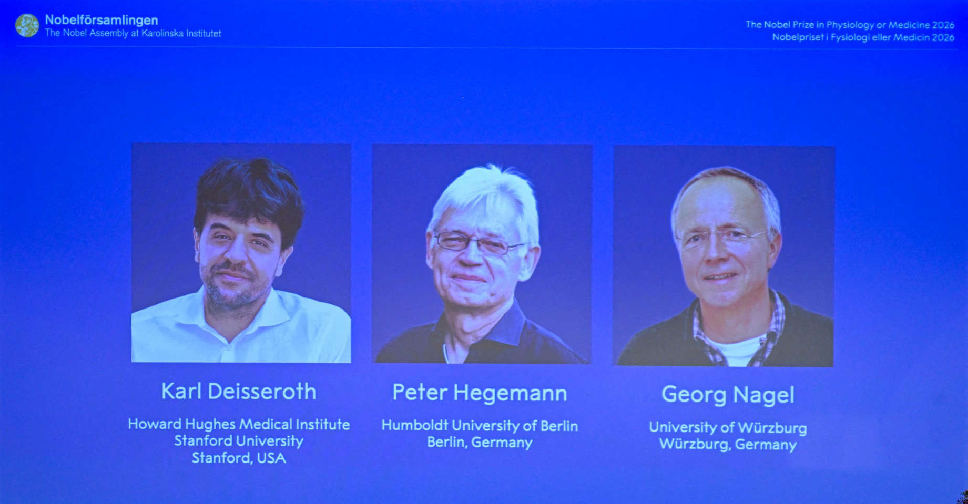
American Karl Deisseroth and Germans Peter Hegemann and Georg Nagel won the 2026 Nobel Prize in Physiology or Medicine on Monday for developing optogenetics, a technique that uses light to control individual nerve cells in the brain.
The Nobel Assembly of Sweden's Karolinska Institutet said Deisseroth, 54, Hegemann, 71, and Nagel, 73, had been selected for their "discoveries concerning light-gated ion channels and optogenetics."
"This method (optogenetics) makes it possible to switch on, or off, the activity of individual nerve cells in a living brain," said Thomas Perlmann, Secretary-General of the Nobel Assembly at Karolinska Institutet.
"This method is now being used in laboratories around the world to reveal the brain's mysteries," he said.
Anna Wedell, a professor in genetics and a member of the Nobel Committee for Physiology or Medicine, said a new era in neuroscience had opened but it was only the beginning.
"For the first time we can actually start to understand how the brain processes information and how different neurons interact across the brain," she said.
The trio will share a prize sum of 12 million Swedish crowns ($1.2 million). Announcements will follow in the coming days on this year's Nobel physics, chemistry, literature, peace and economics prizes, with the winner or winners of the 2026 Nobel Peace Prize to be announced on Friday.
BREAKTHROUGH FROM ALGAE
The breakthrough began in the early 1990s when Hegemann investigated how the alga Chlamydomonas reacts to light in half a millisecond.
He hypothesised that a single protein both captured light and acted as an ion channel.
Nagel tested this hypothesis by injecting Chlamydomonas genes into frog eggs, discovering channelrhodopsin-2, a light-sensitive ion channel.
In 2003, Nagel and Hegemann published findings that this protein could be introduced into human and hamster cells to generate electrical impulses using light.
At Stanford University, Deisseroth demonstrated the technique in rat nerve cells two years later, and the method was named optogenetics in 2006.
"We publish papers together. We have had many discoveries together over the years, had meetings, had beers together, so it's just, it's just absolutely perfect to share with these two," Deisseroth said.
Deisseroth's wife Michelle Monje-Deisseroth, who has conducted pioneering research on brain cancers, said the couple were asleep when they were called by the Karolinska Institutet.
"It was a very welcome wake-up call. I'm very excited and incredibly honoured and I'm just so proud of him," she told Reuters, adding that her husband's work had "really opened up so many new vistas onto normal biology and disease".
TREATMENTS UNDER DEVELOPMENT
The three laureates' research is providing insights about brain disorders. Animal models are being used to understand schizophrenia, Alzheimer's disease, Parkinson's disease, epilepsy and addiction — conditions that affect millions of people worldwide and have limited treatment options.
Deisseroth used optogenetics to control the movements of mouse whiskers by activating specific nerve cells in the motor cortex. He also used light to wake sleeping mice, confirming that specific nerve cells control wakefulness.
"There are mouse models of dementia, epilepsy, addiction. By understanding which cells are active in these diseases in mice, we can understand where to look in humans," Wedell said.
Researchers are also applying the technique to try to restore vision to people blinded by retinitis pigmentosa - a progressive eye disease - by inserting a light-sensitive protein into the retina.
"The patients lose their photoreceptors, the rods and cones in the retina. But healthy cells remain. Researchers use optogenetics to stimulate these healthy cells, activating the optic nerve and generating visual perception in the brain," said Per Svenningsson, Professor of Neurology at Karolinska.
Scientists also hope optogenetics could improve cochlear implants, potentially allowing more precise stimulation of the auditory nerve than current electrical devices.
The most advanced of these treatments are autism spectrum disorder therapy by US-based biotech company MapLight and a vision restoration medicine for retinitis pigmentosa by Nanoscope, which is also based in the United States, though they are both still some time away from reaching patients.
PUSHING BACK BOUNDARIES
Manuel Valero, researcher at Barcelona-based Hospital del Mar, where he heads the Neural Computation Laboratory, said optogenetics had "allowed us to push the boundaries between science and science fiction."
"In laboratory animals, we have managed to control emotions, create false memories or even recover lost memories in models of Alzheimer’s disease," Valero said. "Perhaps the great promise it has yet to fulfil is precisely one of its founding promises: its ability to treat diseases of the human brain."
Boston-born Deisseroth was initially set on neurosurgery, but shifted to psychiatry after encountering suffering patients, asking why depression steals joy and what causes autism.
Hegemann developed an early fascination with science and exploration, and has described scientific research as akin to charting unknown territory.
Nagel became seriously ill at the age of five and spent many summer holidays undergoing surgery. He said he had later worked as a teacher, opened a cafe and took up hang gliding as a hobby.

 Spanish PM Sanchez calls snap election for November 29
 Hundreds of French schools stay closed ahead of nationwide day of student protests
 Thousands of Imran Khan supporters start march to Pakistani capital, party says
 US removes bombers from UK base at centre of suspected Iranian plot
 Omani court sentences two tourists for sitting on nesting turtles