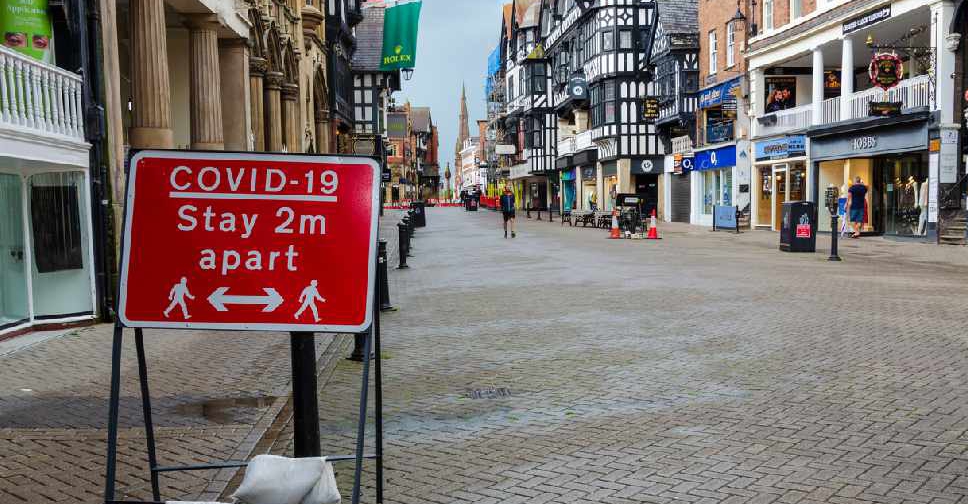
British Prime Minister Boris Johnson delayed his plans to lift COVID-19 lockdown restrictions by a month on Monday.
He warned that the more infectious Delta variant meant if he did nothing thousands more people might die.
Under the final stage of a plan outlined by Johnson in February, he had hoped to lift most social restrictions on June 21, meaning pubs, restaurants, nightclubs and other hospitality venues could fully reopen.
That much-anticipated step was pushed back to July 19.
"I think it is sensible to wait just a little longer," Johnson told a news conference. "As things stand, and on the evidence that I can see right now. I'm confident that we will not need more than four weeks."
The extra time would be used to speed up Britain's vaccination programme - already one of the world's furthest advanced - by shortening the recommended time between doses for those aged over 40 to eight weeks from 12 weeks.
The situation would be reviewed on June 28, which could allow the reopening to be brought forward, although Johnson's spokesman said that was considered unlikely.
In recent weeks there has been fast growth in new cases caused by the Delta variant, first discovered in India.
Health officials believe it is 60% more transmissible than the previous dominant strain and scientists have warned that it could trigger a third wave of infections.
On Monday, Britain recorded 7,742 new COVID-19 cases and three deaths.
Johnson said Britain was seeing cases growing by about 64% per week and the number of people in hospital intensive care was rising.
"By being cautious now we have the chance in the next four weeks to save many thousands of lives by vaccinating millions more people," he said.
Britain has officially reported almost 128,000 deaths since the start of the pandemic, the seventh highest number globally.
Monday's decision was based on scientific modelling which showed that, if the reopening went ahead as planned, under some scenarios hospitalisations could match those in March last year when ministers feared the health system could be overwhelmed.
A study earlier on Monday showed the Delta variant doubles the risk of hospitalisation, but two doses of vaccine still provide strong protection.
Unlike in March 2020, the increase in hospitalisations was likely to be among younger people who require shorter treatment and are less at risk of dying.
Nevertheless, the risk of increased pressure on the health system meant that the tests the government set out for going ahead with the reopening had not been met.
Johnson sets COVID-19 restrictions for England, with devolved administrations in Scotland, Wales and Northern Ireland making their own policy.


 US military to begin Iran maritime blockade on Monday
 Hungary's Orban concedes landmark election defeat
 Trump vows to blockade Strait of Hormuz after Iran peace talks stumble
 Nigerian airstrike hits market, 200 feared dead
 Russia, Ukraine trade accusations of ceasefire violations