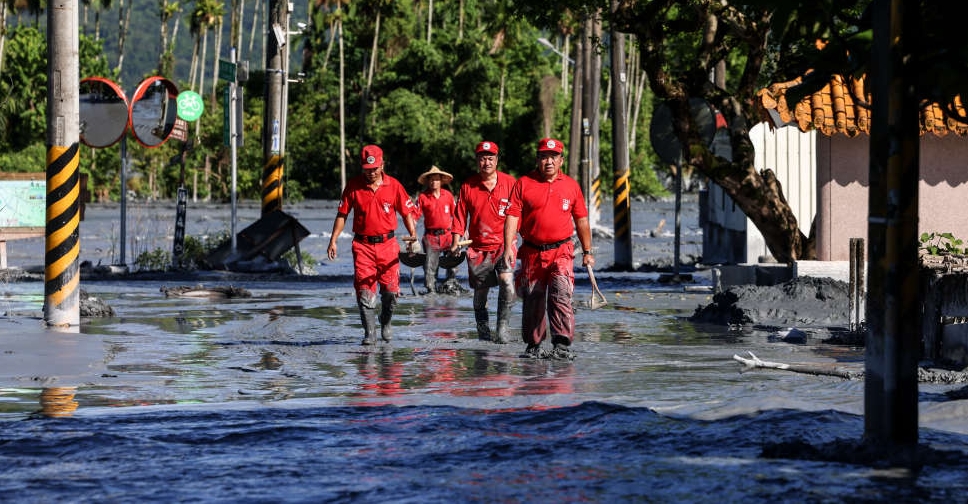
Rescue workers in Taiwan battled through thick mud on Friday, looking for 11 people still missing after Super Typhoon Ragasa this week sent a wall of water into a small town on the east coast.
The flooding's death toll held steady at 14.
The heavy rains in Hualien county caused a so-called barrier lake in the mountains to overflow on Tuesday and release a thick sludge of water and mud on the town of Guangfu.
While the flood waters have receded, the dark grey mud continues to blanket large parts of the area, creating problems for residents and rescuers alike.
Rescue workers, sometimes wading in mud up to their waists, have been cutting holes in the roofs of buildings to check for missing people.
A man who gave his family name as Hwang said he was still looking for his elder sister's body. "She died in the house because it was completely filled with mud and there was no way to get her out," he said.
Many of the deaths occurred on the first floors of houses after people, often elderly, were unable to follow government orders to move upstairs and out of the way.
Huang Ju-hsing, 88, has been trapped inside his second-floor home after the flooding blocked access to his family-run grocery store downstairs.
"There was no time to escape. We told him to hurry up and go upstairs," said his wife Chang Hsueh-mei, who has been able to scramble over the wreckage downstairs and get outside. "When you're faced with an emergency, you suddenly find the courage to do anything," said Chang, 78, after climbing through aisles of fallen objects to reach her husband.
Mountainous, sparsely populated and largely rural, Hualien is one of Taiwan's top tourist destinations due to its wild beauty.
What to do about the barrier lake, formed by earlier typhoons and which has now shrunk in size to only 12 per cent of what it was before the disaster, remains an unresolved issue.
Barrier lakes are formed when rocks, landslides or other natural blockages make a dam across a river, normally in a valley, blocking and holding back water, hindering or even stopping natural drainage.
The government has ruled out using explosives to break through the bank holding up the water, fearing it could bring more landslides and worsen the situation.
The disaster has not impacted Taiwan's crucial semiconductor industry, located on the island's west coast.

 Iran threatens to retaliate for US blockade
 Israel presses assault on Lebanon border town ahead of US-hosted talks
 Hungarian election winner Magyar vows to fight graft, change constitution
 One killed in Ukraine despite Easter ceasefire, officials say
 Haiti declares three days of national mourning for 25 killed in stampede