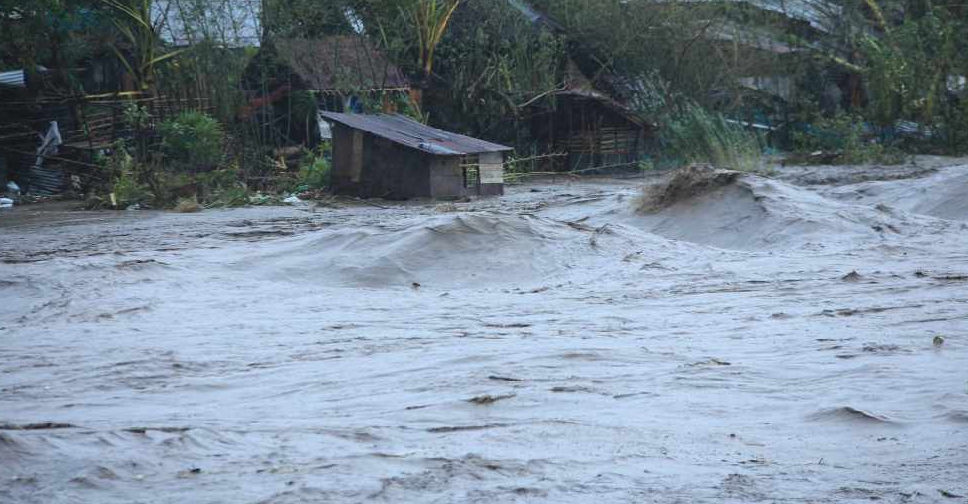
At least four people died in a super typhoon on the Philippines' main island of Luzon on Sunday.
Video footage by news channels and on social media showed storm surges in some coastal towns, rivers overflowing and dikes destroyed, submerging villages in Bicol region.
Some houses were buried under volcanic mudflows, and power supply and communications service were cut off.
The four deaths were in Albay province in Bicol, where Typhoon Goni made landfall twice, said Governor Al Francis Bichara.
The storm weakened further after making a third landfall in southern Luzon, but the weather bureau warned another cyclone, tropical storm Atsani, has entered the country and could gain strength.
The world's strongest storm this year, which was a super typhoon when it initially hit eastern provinces, made a third landfall in Quezon province before it weakened with 165 kph sustained winds and gusts of up to 230 kph.
By late afternoon, Goni was spotted moving towards Batangas and Cavite provinces, south of the capital Manila, where residents could experience "destructive winds and intense rainfall" by night time, the weather bureau said.
The disaster management agency has not confirmed the reported deaths.
In Quezon, Governor Danilo Suarez said power supply was cut in 10 towns as Goni toppled trees.
About 347,000 people were in evacuation centres, said disaster management chief Ricardo Jalad, lowering the figure of nearly a million reported by the agency on Saturday.
President Rodrigo Duterte was monitoring the government's disaster response from his southern hometown Davao city, presidential spokesman Harry Roque said.
Health officials reminded evacuees to observe social distancing as the coronavirus spread is also a concern.
Dozens of flights have been cancelled as Manila's main gateway, the Ninoy Aquino International Airport, was ordered shut for one day.
The agriculture ministry expected minimal crop damage saying 1.07 million tonnes of unmilled rice and 45,703 tonnes of corn had been saved from the typhoon's onslaught because of an early pre-disaster advisory to farmers.
Goni, among the strongest storms to hit the Philippines since Haiyan killed more than 6,300 people in 2013, was moving towards the South China Sea.
It follows Typhoon Molave, which hit the Philippines last month killing 22 people, mostly through drowning in provinces south of Manila.


 Trump vows to blockade Strait of Hormuz after Iran peace talks stumble
 Nigerian airstrike hits market, 200 feared dead
 Russia, Ukraine trade accusations of ceasefire violations
 At least 30 dead in stampede at Haiti’s historic Laferriere Citadel
 Cyclone lashes New Zealand's North Island, hundreds evacuated