Sri Lanka's main opposition party on Friday asked the government to resolve an economic crisis or face a no-confidence motion, as leaders of businesses from garments to tea and other industries warned that exports could fall up to 30 per cent this year.
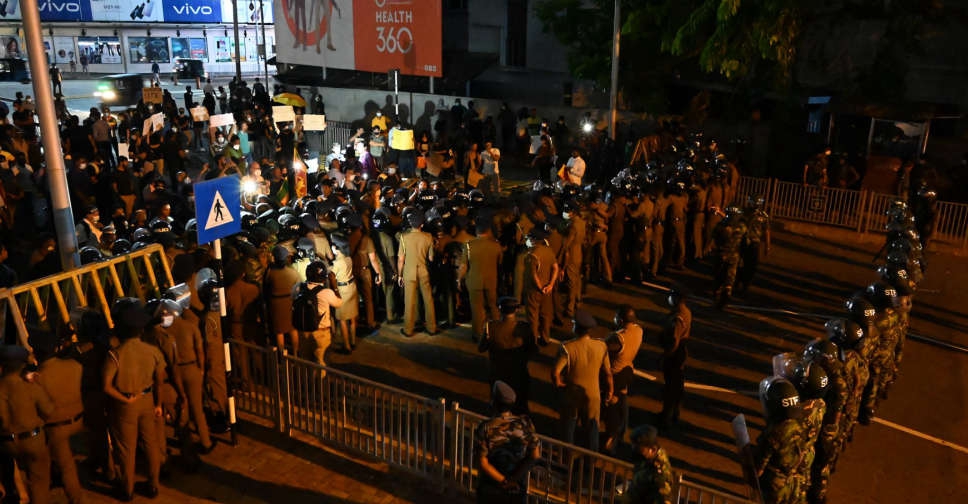
The heavily indebted country has little money left to pay for imports, which has led to crippling shortages of fuel, power, food, and increasingly, medicine. Street protests have gone on nearly non-stop for more than a month, despite a five-day state of emergency and a two-day curfew.
President Gotabaya Rajapaksa is running his administration with only a handful of ministers after his entire cabinet resigned this week, while the opposition and even some coalition partners rejected calls for a unity government to deal with the worst crisis in decades.
At least 41 lawmakers have walked out of the ruling coalition to become independents, though the government says it still has a majority in parliament.
"The government needs to address the financial crisis and work to improve governance, or we will move a no-confidence motion," Sajith Premadasa, leader of Samagi Jana Balawegaya opposition group, said in parliament.
"It is imperative that Sri Lanka must avoid a disorderly debt default. The government must work to suspend debt and appoint financial advisers to start off the process of restructuring debt."
Parliament proceedings were suspended twice in the morning as rivals heckled each other, with two members temporarily removed from the chamber on the orders of the speaker.
Nearly two dozen associations, representing industries that collectively employ a fifth of the country's 22 million people, together urged the government to quickly seek financial help from the International Monetary Fund (IMF), the World Bank and the Asian Development Bank (ADB).
"We need a solution within weeks or the country will fall off the precipice," Rohan Masakorala, director-general of the Sri Lanka Association of Manufacturers And Exporters of Rubber Products, told a news conference.
"Our estimate is that both merchandise and service exports could drop 20-30% this year due to a dollar shortage, higher freight costs and power cuts."
RESERVES PLUNGE
Rajapaksa is struggling to find a new finance minister to hold talks this month with the IMF for emergency loans, after Ali Sabry submitted his resignation on Tuesday having spent just a day in office. A ruling party lawmaker said Rajapaksa had yet to accept Sabry's resignation.
"We are pushing the government and opposition to establish political stability as soon as possible and give us a way forward," Masakorala said. "IMF should have happened yesterday."
Sri Lanka's foreign exchange reserves have plunged some 70 per cent in the past two years, hitting $1.93 billion at the end of March. It has a debt of $1 billion due for payment in July, and more later in the year.
Inflation, meanwhile, has rocketed to its highest level in more than a decade, and on Friday evening, the Central Bank of Sri Lanka is expected to raise key interest rates by as much as 400 basis points (bps) following a 100 bps rise in early March.
The government has secured credit lines and currency swaps of billions of dollars from India and China but industry leaders say it needs to do more, urging the central bank governor to start negotiations urgently.
"The Indian credit lines will only last until end-April," said Russell Juriansz, chairman of the Sri Lanka Shippers' Council.
"We appeal to the president to take the right decision or it will haunt him for the rest of his life."
In addition to importing essential medicines through a $1 billion credit line with India, Sri Lankan authorities are also in discussions with the World Health Organisation, the World Bank and the ADB for supplies of drugs, government health official Saman Rathnayake told Reuters.


 US military to begin Iran maritime blockade on Monday
 Orban ousted after 16 years as Hungarians flock to pro-EU rival
 Trump vows to blockade Strait of Hormuz after Iran peace talks stumble
 Nigerian airstrike hits market, 200 feared dead
 Russia, Ukraine trade accusations of ceasefire violations