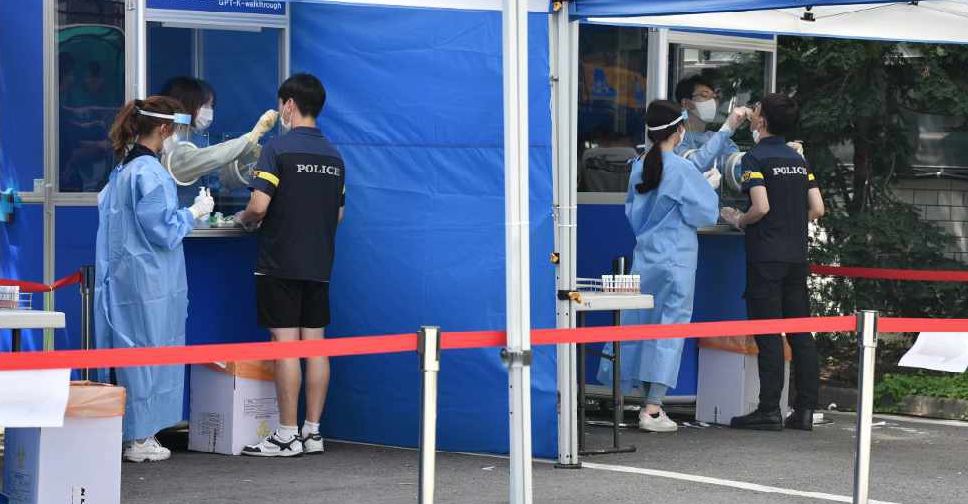
South Korea reported on Wednesday its highest daily rise in novel coronavirus cases since early March as outbreaks from churches around the capital spread.
The 297 new infections mark the sixth straight day of triple-digit increases in a country that has managed to blunt several previous outbreaks.
The national tally rose to 16,058 infections with 306 deaths, according to data from the Korea Centers for Disease Control and Prevention (KCDC).
Nearly 90 per cent of the new cases appeared in the capital, Seoul, and surrounding areas, raising concern of the rapid spread of the virus in a metropolitan area of more than 25 million people.
"We're in a desperately dangerous crisis where infections are spreading in the Seoul metropolitan area and threatening to lead to a massive nationwide transmission," Vice Health Minister Kim Gang-lip told a briefing.
"The government cannot contain the current spread only with tracing and isolation... please stay home unless you must go out."
At least 166 of the new infections are linked to the Sarang Jeil Church, taking the number of cases from it to 623.
Authorities have mobilised some 8,500 police to trace another 600 members of the church's congregation who should be in isolation, and they are trying to test all of its 4,000 members.
Some members of the church are reluctant to come forward and get tested, or to self-isolate, officials have said.
Many of them also attended anti-government rallies in Seoul on the weekend where thousands of people gathered from across the country, raising fears infections were seeded there.
KCDC deputy director Kwon Jun-wook said 10 people at the protests with no ties to the church had been infected and urged everyone who attended to get tested.
Prime Minister Chung Sye-kyun vowed to take legal action against the church for any attempt to disrupt tracing and testing efforts by failing to provide accurate membership lists.
At least three other smaller clusters have been traced to churches in Seoul and one to a church in the city of Yongin. More than 50 cases have been linked to a coffee outlet in the city of Paju.
Nightclubs, buffets and cyber cafes have been ordered to close in Seoul and surrounding regions.
In-person church services have also been banned while indoor and outdoor gatherings have been restricted to no more than 50 and 100 people, respectively.


 US leaves Iran peace talks without a deal
 At least 30 dead in stampede at Haiti’s historic Laferriere Citadel
 Cyclone lashes New Zealand's North Island, hundreds evacuated
 US-Iran talks pause for now, disagreements remain
 Costa Rica receives first group of deported migrants under agreement with US