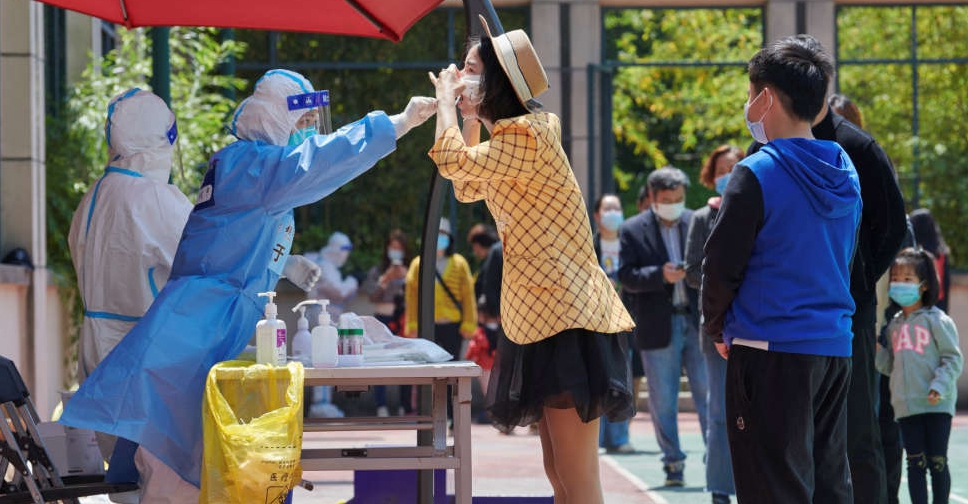
Shanghai authorities on Tuesday pleaded for public cooperation with a massive new push to test most of the population for COVID-19 as the city steps up efforts to bring community transmission down to zero after nearly three weeks of lockdown.
The plea came as some people refused to join PCR testing queues out of weariness after weeks of such requirements, or fear it puts them at greater risk of infection.
Residents shared stories on social media about busloads of people being taken from their homes and sent into quarantine, including babies and the elderly.
Authorities are under pressure from Beijing to speed up transfers of positive cases and their close contacts to quarantine centres, fueling angst in the community about draconian measures designed to completely stop the spread of the virus rather than just slow it down.
"By conducting multiple, consecutive rounds of PCR testing we will be able to dynamically detect positive cases as early as possible, as this will help us to reach zero-COVID at community level more quickly," city health official Hu Xiaobo said.
Sources have told Reuters that Shanghai aims to stop the spread of COVID-19 outside quarantined areas by Wednesday. The target marked a turning point when achieved by other locked-down Chinese cities, allowing them to further ease curbs.
The number of new local transmissions detected on Monday fell to 19,442 from 21,395 the previous day. Shanghai found 550 cases outside the quarantine zones, down from 561 the day before and the fourth consecutive decline.
While Shanghai has not yet said how it will open up, it is working towards that goal by carrying out daily PCR and antigen testing for millions of residents and accelerating quarantine transfers.
China's COVID elimination strategy requires testing, tracing and centrally quarantining all positive cases and their close contacts. While tens of thousands of people have already been sent to isolation facilities, many more are forced to isolate in their homes due to their proximity to infected people.
The city has eased movement curbs for some people in low-risk areas, but the vast majority of its 25 million population remain in strict lockdown.
Public transport is shut, unapproved vehicles are not allowed on the roads and the only people able to move around relatively freely are the police, delivery drivers, neighbourhood committee members and healthcare workers.
Health experts have called for clarity on how China defines zero transmission outside quarantined areas.
Wu Zunyou, chief epidemiologist at the China Center for Disease Control and Prevention, said on his Weibo account that it meant there were no cases "freely active" among the people.


 US military to begin Iran maritime blockade on Monday
 Hungary's Orban concedes landmark election defeat
 Trump vows to blockade Strait of Hormuz after Iran peace talks stumble
 Nigerian airstrike hits market, 200 feared dead
 Russia, Ukraine trade accusations of ceasefire violations