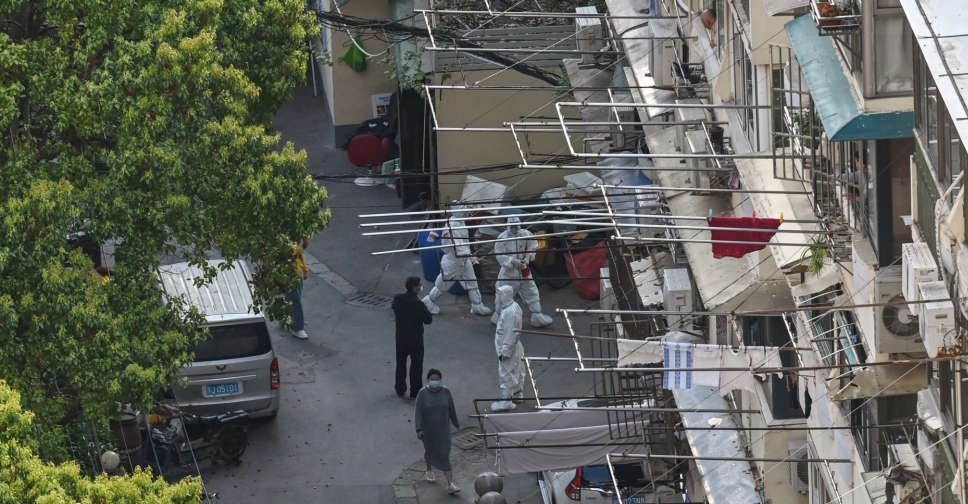
Some residents of Shanghai stepped out of their homes for the first time in more than two weeks on Tuesday, as the city took tentative steps towards easing a COVID-19 lockdown amid mounting worries over the economic impact of the strict curbs.
Shanghai said on Monday that more than 7,000 residential units had been classified as lower-risk areas after reporting no new infections for 14 days, and its districts have since been announcing which specific compounds can be opened up.
But while some people were allowed out of their residences on Tuesday, there was still confusion about the extent to which those in the lower-risk zones were free to move, with many still awaiting permission from their residential committees.
City health official Wu Qianyu said at a press briefing that residents from lower-risk zones known as "prevention areas" were still subject to controls and would have to observe strict social distancing measures.
"After a long period of lockdown, it is understandable that people want to go out and get some air, and they need to go shopping for food and medicine and go for medical treatment," she said. "But if lots of people gather in a disorderly way, it will cause hidden dangers to our epidemic prevention work."
With the economy under increasing strain, efforts are being made in Shanghai to reopen supermarkets, convenience stores and pharmacies, but non-essential businesses will remain suspended, said Liu Min, vice head of the city's commercial commission.
Nomura estimates that as many as 45 cities in China are now implementing either full or partial lockdowns, making up 26.4 per cent of the country's population and 40.3 per cent of its GDP.
The figure of 45 cities may even underestimate the full impact of China's current "zero COVID" policies, with mobility disrupted elsewhere too, it added.
Premier Li Keqiang warned on Monday that China needed to be "highly vigilant" against further downward pressures on the economy and said the fight against COVID-19 needed to be "coordinated" with economic and social development.
China is also encouraging long-term investors to buy more equities and major shareholders of listed firms to increase their holdings when stocks slump, in a bid to stabilise a stock market rocked by the worsening COVID outbreak, the country's securities watchdog said late on Monday.
Shanghai recorded 22,348 new asymptomatic coronavirus cases on April 11, down from 25,173 a day earlier. Confirmed symptomatic cases stood at 994, up from 914.


 Hungary's Orban concedes landmark election defeat
 Trump vows to blockade Strait of Hormuz after Iran peace talks stumble
 Nigerian airstrike hits market, 200 feared dead
 Russia, Ukraine trade accusations of ceasefire violations
 At least 30 dead in stampede at Haiti’s historic Laferriere Citadel