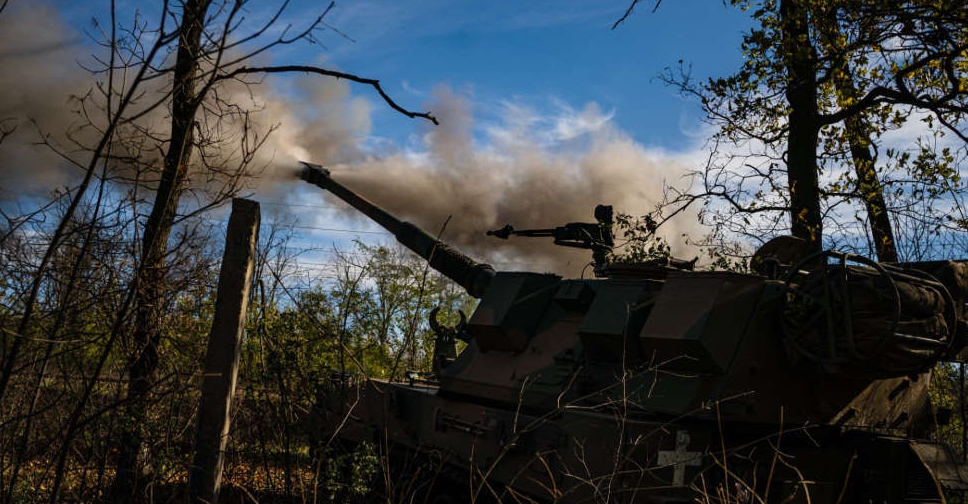
Russian missiles pounded Ukrainian energy and other facilities, causing blackouts in various regions, Kyiv said, while Russian occupation authorities in the southern city of Kherson urged civilians to evacuate.
Ukrainian President Volodymyr Zelenskiy said the Russian attacks had struck on a "very wide" scale. He pledged his military would improve on an already good record of downing missiles with help from its partners.
With the war about to start its ninth month and winter approaching, the potential for freezing misery loomed as Russia continued to attack Ukraine's power grid.
In Kherson, a target for Ukraine's aggressive counterattack to the invasion Russian President Vladimir Putin launched on February 24, the occupation authorities instructed civilians to get out.
"Due to the tense situation at the front, the increased danger of massive shelling of the city and the threat of terrorist attacks, all civilians must immediately leave the city and cross to the (east) bank of the Dnipro!" occupation authorities posted on Telegram.
Thousands of civilians have left Kherson after warnings of a Ukrainian offensive to recapture the city.
At Oleshky on the opposite bank of the Dnipro, Reuters saw people arriving by river boat from Kherson, loaded with boxes, bags and pets. One woman carried a toddler under one arm and a dog under the other.
"I really didn't want to (leave), I'm still in work," one resident said. "We wanted to stay here in the region, but now we don't know."
Ukraine's military said it was making gains as its forces moved south through the region, taking over at least two villages it said Russian troops had abandoned. Kherson links Ukraine to the Crimean Peninsula, which was annexed by Russia in 2014.
Deputy Prime Minister Iryna Vereshchuk said on Telegram: "Kherson region! Just a little bit more. Hang in there. The Ukrainian Armed Forces are at work."
Reuters could not independently verify the accounts.
'MASS STRIKE'
Since October 10, Russia has launched devastating salvos at Ukraine's power infrastructure, hitting at least half its thermal power generation and up to 40 per cent of the entire system.
Officials in a swath of regions on Saturday reported strikes on energy facilities and power outages as engineers scrambled to restore the network. Governors advised residents to stock up on water.
More than a million people were without power, said presidential adviser Kyrylo Tymoshenko. Parts of Kyiv suffered power cuts into the evening, and a city official warned strikes could leave Ukraine's capital without power and heat for "several days or weeks".
Presidential aide Mykhailo Podolyak said Moscow wanted to create a new wave of refugees into Europe with the strikes, while Foreign Minister Dmytro Kuleba said on Twitter the attacks constituted genocide.
Moscow has acknowledged targeting energy infrastructure but denies targeting civilians.
Zelenskiy, in his nightly video address, said the "latest mass strike" affected regions in western, central and southern Ukraine.
"Of course we don't have the technical ability to knock down 100 per cent of the Russian missiles and strike drones. I am sure that, gradually, we will achieve that, with help from our partners. Already now, we are downing a majority of cruise missiles, a majority of drones."
Ukrainian forces had downed 20 missiles and more than 10 Iranian-made Shahed drones on Saturday, he said. The air force command earlier had said 33 missiles had been fired at Ukraine, with 18 shot down.
No new developments were reported regarding the Nova Kakhovka dam. Zelenskiy on Friday urged the West to warn Moscow not to blow up the Russian-controlled dam on the Dnipro.
Russia has accused Kyiv of rocketing the dam and planning to destroy it in what Ukrainian officials called a sign that Moscow might blow it up and blame Kyiv. Neither side has produced evidence to back up their allegations.
The Soviet-era structure holds back 18 cubic km of water, about equal to the Great Salt Lake in the US state of Utah. Its destruction could devastate much of the Kherson region. It supplies water to Crimea and the Russian-held Zaporizhzhia nuclear power plant.
Regarding the Zaporizhzhia plant, considered a potential flashpoint for catastrophe, the Group of Seven industrial powers on Saturday condemned Russia's kidnapping of the Ukraine-operated plant's leaders and called for the immediate return of full control of the plant to Ukraine.


 US hosts Lebanese and Israeli envoys as Israel presses war on Hezbollah
 US, Iran may resume talks this week despite port blockade
 Around 250 missing after Rohingya boat capsizes in Andaman Sea
 Russia launches more than 300 drones, missiles at Ukraine overnight
 Canada, UK, Australia and Japan call for 'urgent end to hostilities in Lebanon'