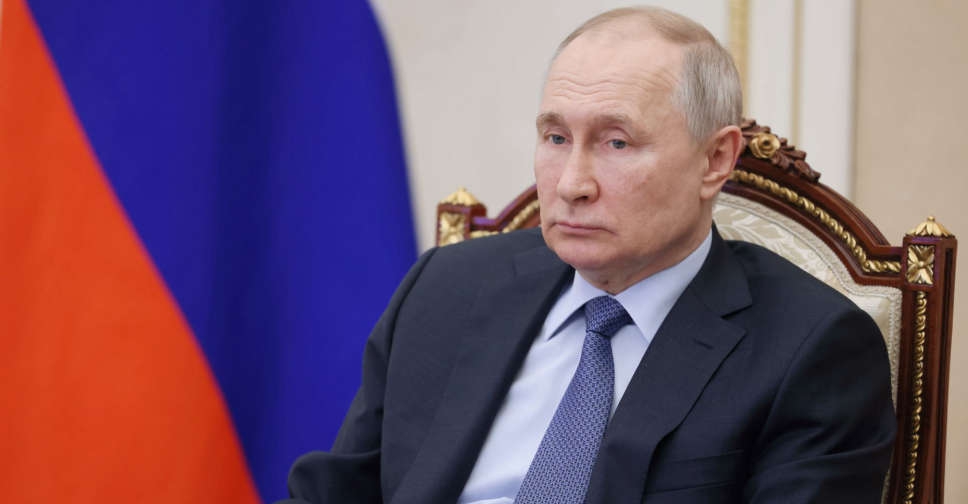
President Vladimir Putin offered no compromise on his terms for ending the war in Ukraine on Friday and accused the European Union of attempting "daylight robbery" of Russian assets.
Putin set out the Kremlin's stance on the war in the opening moments of his annual end-of-year press conference, a marathon event that typically runs for some four hours.
He said he did not see readiness on the Ukrainian side to agree a peace deal, but there were "certain signals" it was willing to engage in dialogue.
"The only thing I want to say is that we have always said this: we are ready and willing to end this conflict peacefully, based on the principles I outlined last June at the Russian Ministry of Foreign Affairs, and by addressing the root causes that led to this crisis," Putin said.
He was referring to a speech 18 months ago in which he demanded that Ukraine abandon its ambition of joining the NATO military alliance and withdraw entirely from four regions that Russia has claimed as its own territory. Kyiv refuses to give up land that Moscow's forces have failed to capture in nearly four years of war.
ASSESSMENT OF BATTLEFIELD SITUATION
Putin was speaking hours after European Union leaders set aside a plan to use frozen Russian assets as backing for a loan to Ukraine, deciding instead to borrow cash to help fund Kyiv's defence against Russia for the next two years.
The EU leaders said they reserved the right to use Russian assets to repay the loan if Moscow fails to pay war reparations to Ukraine.
Putin said the bloc had backed away from the original scheme because it would have faced serious repercussions, and it had damaged its status as a safe place to store assets.
"Theft is not the appropriate term... It's daylight robbery. Why can't this robbery be carried out? Because the consequences could be grave for the robbers," he said. "This isn't just a blow to their image; it's an undermining of trust in the euro zone, and the fact that many countries, not just Russia, but primarily oil-producing countries, store their gold and foreign exchange reserves in the euro zone."
ON-SCREEN GLITCHES
After nearly four years, the war stands at a delicate juncture as US President Donald Trump pushes for a peace deal on terms that Ukraine and its European allies fear will be slanted towards Russia.
Russia says it is waiting to hear from Washington how its draft peace proposals have been modified following consultations between the United States, Ukraine and the Europeans.
The state of the conflict - and the question of when it will end - dominated the first phase of the "Direct Line" event, which Putin has held in different formats most years since 2001.
He typically uses it to field dozens of questions on everything from nuclear weapons to the price of eggs. Some are posed by journalists and others by ordinary Russians, who can submit them online or by phone.
The Kremlin said it had received more than 2.6 million questions in advance. It styles the event as a demonstration of Putin's openness to respond to questions on any topic, and his willingness to respond to the concerns of citizens.
STATE OF THE FRONT LINES
Putin laid out a detailed assessment of the battlefield situation, saying Russia was advancing along the entire front line and Ukrainian forces were in retreat.
At one point he gave the floor to Naran Ochir-Goryaev, a senior lieutenant and decorated Hero of Russia who described his part in Russia's storming of the Ukrainian town of Siversk.
Putin apologised to the widow of a soldier killed in action, who said her family had not yet received the compensation due to them.
Ukraine says Russian gains are incremental and have come at the cost of huge casualties. It says it is fighting back in locations such as Kupiansk in the northeast, which Russia said it had captured last month.
Kyiv has long called for a ceasefire and said it does not believe that Putin is serious about seeking peace. Russia says it is Ukraine that is refusing to come to the table.
Putin said a sharp slowing in the Russian economy - to 1 per cent growth this year from 4.3 per cent in 2024 - was the result of conscious actions by the central bank to bring down the rate of inflation.
While his press conference was under way, the bank - under heavy pressure from businesses, banks and some politicians to bring down interest rates - announced it was cutting its key rate by half a percentage point to 16 per cent.

 US to blockade Iran on Monday after talks fail to yield a deal
 Haiti declares three days of national mourning for 25 killed in stampede
 Australia appoints woman to lead its army for the first time
 Orban ousted after 16 years as Hungarians flock to pro-EU rival
 Trump vows to blockade Strait of Hormuz after Iran peace talks stumble