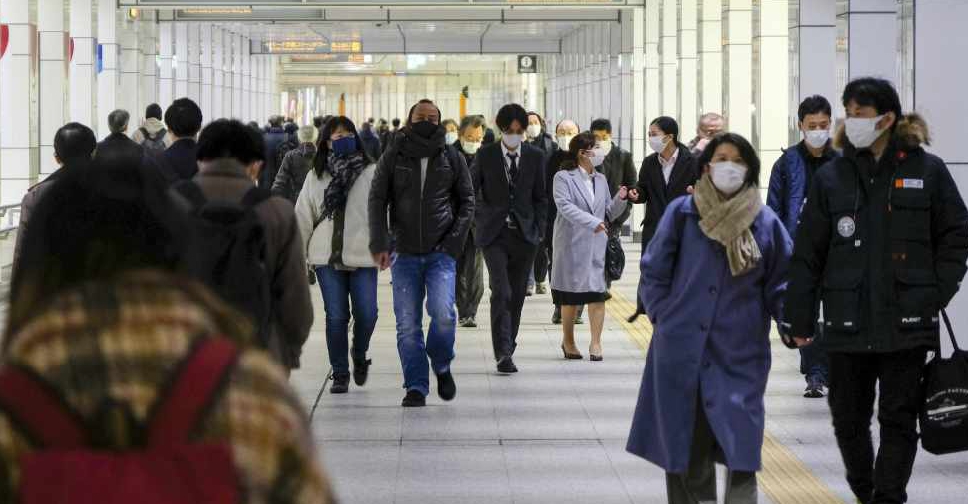
An advisory panel has approved the Japanese government's plan for a month-long state of emergency for Tokyo and three neighbouring prefectures in a bid to contain a surge in new coronavirus cases.
The proposal for an emergency declaration running from January 8 to February 7 was approved at a morning meeting, Economy Minister Yasutoshi Nishimura said.
Its restrictions centre on measures to combat transmission at bars and restaurants, cited by the government as key risk areas.
Though still less seriously affected by the pandemic than many countries around the world, Japan saw new daily infections top 6,000 for the first time on Wednesday.
Positive tests are set to exceed 2,000 on Thursday in Tokyo, yet another record after hitting 1,591 the previous day, according to public broadcaster NHK.
Prime Minister Yoshihide Suga will hold a news conference at 6:00 pm (0900 GMT) to formally announce the decision and curbs to be imposed in Tokyo and the neighbouring Saitama, Kanagawa and Chiba prefectures. But medical experts have said they fear the government's plans might be inadequate, with new cases hitting highs around the country.
Government officials have been in talks with experts this week to assess steps to try to bring the surge under control with as little damage as possible to the economy.
With an eye on the looming Tokyo Olympics and the fragile state of the world's third-biggest economy, Suga has favoured limited restrictions.
Economy Minister Nishimura said on Thursday that measures to be included in the state of emergency would require residents to refrain from non-urgent outings, and limit attendance at sporting and other big events to 5,000 people.
Ahead of the declaration, the Tokyo Metropolitan Government announced on Thursday that upcoming exhibitions of the Olympics torch around the capital have been postponed "to reduce the flow of people and the further spread of COVID-19."
Prime Minister Suga has said shorter operating hours for such businesses had helped bring cases down in regions such as Osaka and Hokkaido.
But in a worrying sign, Osaka on Wednesday reported new cases easily topped their previous record, with 560 infections, while Hokkaido saw cases surpass 100 for the first time in a week.
"Depending on the way infections spread from here on, we may need to think about a state of emergency nationwide," Toshio Nakagawa, president of the Japan Medical Association, told a news conference on Wednesday.


 Trump welcomes Xi to Washington looking for a trade win
 India's 'cockroach' party threatens protest if election chief doesn't quit in 48 hours
 Russian strikes kill eight in Ukraine, damage maternity clinic
 White House reinstates media access following judge's order
 Australia says OpenAI agent hacked into government website