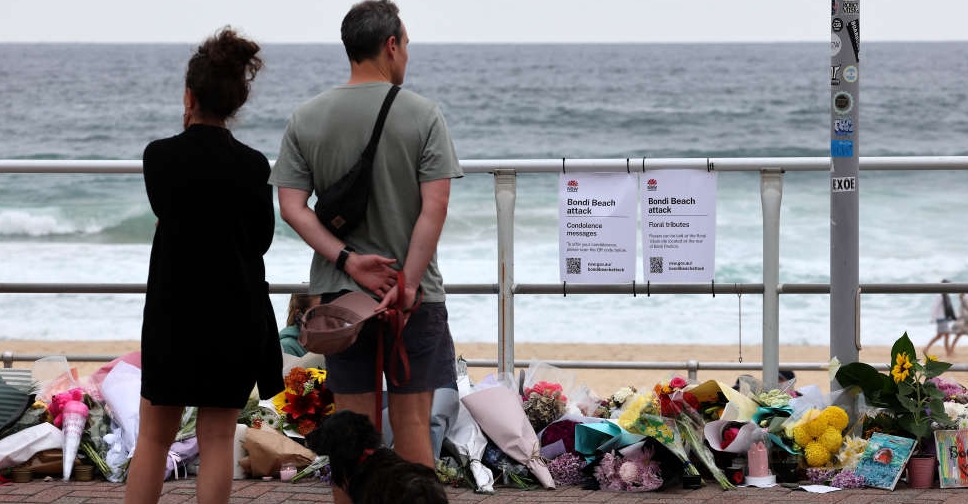
The alleged gunman shot dead by police during Sunday's attack on Australia's Bondi beach was originally from the southern Indian city of Hyderabad and his family did not know about his 'radical mindset', Indian police said on Tuesday.
Fifteen people were killed in the attack on a Hanukkah event, Australia's worst mass shooting in nearly 30 years, and it is being investigated as an act of terrorism targeting the Jewish community.
In a statement providing more details about the man alleged to have carried out the attack with his son as an accomplice, police in the southern Indian state of Telangana said Sajid Akram, 50, had got a degree in commerce in Hyderabad, the large and bustling tech and pharma hub that is the state capital.
Akram then moved to Australia in November 1998 to find work and married a woman described as of European origin, with whom he had a son and a daughter.
He went back to India six times for family-related reasons such as property matters and to visit his parents but did not return when his father died, the police statement said.
It said Akram's family seemed unaware of his 'radicalisation' and it appeared unconnected with India, where police had no adverse record of him before he left in 1998.
"The family members have expressed no knowledge of his radical mindset or activities, nor of the circumstances that led to his radicalisation," the statement said.
"The factors that led to the radicalisation of Sajid Akram and his son, Naveed, appear to have no connection with India or any local influence in Telangana."
FAMILY HOME IN HYDERABAD
When Reuters on Tuesday visited Zehra Cottage, Akram's family home in the Al Hasnath colony of Hyderabad's Tolichowki area, the three-storey building's gates were shut. No family members were to be seen.
Most neighbours were unwilling to speak to reporters. One neighbour said a doctor lived in the house, referring to Akram's brother. His elderly mother also stays with them, he said.
"We heard he (the brother) is a doctor," said the neighbour, who spoke on condition of anonymity.
"This is a silent and peaceful colony. We have never interacted with them or the family. No one in the colony has any criminal history or has attracted police attention before."
Australian police said Akram and his 24-year-old son Naveed, who was identified by Australian media as his alleged accomplice and is in critical condition in hospital after also being shot, had travelled to the Philippines last month.
The father travelled on an Indian passport and the son on an Australian one, and the purpose of the trip is under investigation, officials said, adding that it was not conclusive they were linked to any terrorist group or whether they received training in that country.

 Iran threatens to retaliate for US blockade
 Israel presses assault on Lebanon border town ahead of US-hosted talks
 Hungarian election winner Magyar vows to fight graft, change constitution
 One killed in Ukraine despite Easter ceasefire, officials say
 Haiti declares three days of national mourning for 25 killed in stampede