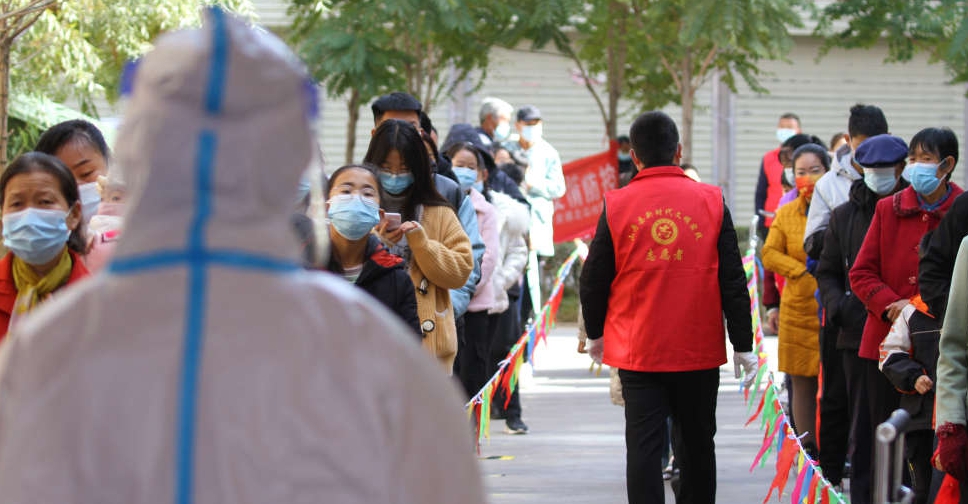
A few border cities in northeastern China started to tighten COVID-19 measures, restricting travel and limiting gatherings in public spaces, and some declared a "pre-war" mode of vigilance and monitoring, as China combats an outbreak hitting mainly the north.
China reported 23 locally transmitted symptomatic cases for Wednesday, official data showed on Thursday, down from 50 a day earlier, bringing the total number to 270 since October 17, when the current outbreak began.
Although the tally is tiny versus many clusters outside China, the spread to over a dozen provincial areas and a zero-tolerance policy have forced local officials to toughen restrictions, again squeezing the service sector including tourism and catering companies in a slowing economy.
In northeastern Heilongjiang province, which shares a border with Russia, Heihe city detected one local confirmed case, plus three asymptomatic cases, which China counts separately from patients with confirmed symptoms, for October 27.
The city of 1.3 million demanded the suspension of manufacturing activities and business operations in urban areas, except for essential ones.
It banned people and vehicles in those urban areas from leaving and suspended entry into the areas for non-essential reasons via public roads, while halting bus and taxi services.
Flights from the city and some train services were cut, local media said on Wednesday.
It remains unclear how the Heihe cluster started, or whether any of the infected were linked to outbreaks in other regions.
'EXTREME CAUTION'
China's high vaccination rate would in principle allow it to shift to a less disruptive endemic strategy, said Julian Evans-Pritchard, senior China economist at Capital Economics.
As of October 23, 76 per cent of China's 1.41 billion population have received complete doses.
"But extreme caution prevails," he said. "Any shift seems unlikely until at least after the Winter Olympics in February."
Jiamusi city, also on the Heilongjiang-Russia border, has yet to report local cases in the latest outbreak, but said it will be on alert for a week until November 3.
It required tourist sites to bar tourists from outside of Jiamusi, demanded reduction in gatherings and halted visits to elderly homes and mental health facilities.
Another two cities in Heilongjiang, Jixi and Mudanjiang, pledged to enter into a "pre-war" mode of high vigilance and stringent monitoring, though no local infections have been reported yet in the past week.
Some small border towns in northwestern and southwestern China, battling a higher risk of infections imported from overseas while equipped with relatively few resources, have suffered more severe disruptions than richer cities in China's efforts to clear infections.


 US-Iran peace talks end without agreement, delegations leave Pakistan
 Russia, Ukraine trade accusations of ceasefire violations
 At least 30 dead in stampede at Haiti’s historic Laferriere Citadel
 Cyclone lashes New Zealand's North Island, hundreds evacuated
 US-Iran talks pause for now, disagreements remain