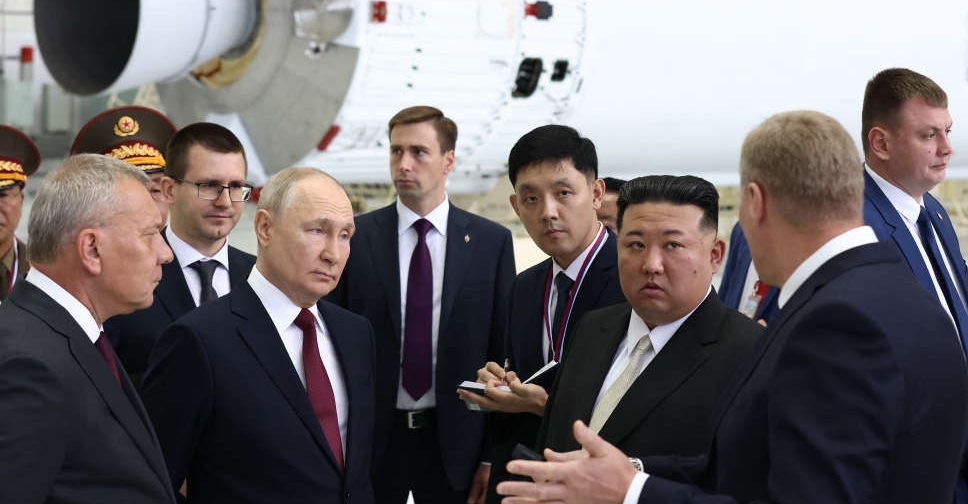
North Korea fired two ballistic missiles off its east coast, South Korea's Joint Chiefs of Staff and the Japanese Coast Guard said on Wednesday, just hours before leader Kim Jong Un was expected to meet President Vladimir Putin in Russia.
It was the first such launch to occur while Kim was abroad for a rare trip, analysts said.
No details on the size or range of the missiles were immediately available. But about five minutes after the first launch warning, Japan's Coast Guard reported the missile had fallen into the sea.
Japan's Chief Cabinet Secretary Hirokazu Matsuno told reporters that Japan had lodged a protest against North Korea through diplomatic channels in Beijing.
Both missiles fell in the sea outside Japan's exclusive economic zone (EEZ), he added.
The nuclear-armed North has conducted regular launches of everything from short-range and cruise missiles to massive intercontinental ballistic missiles (ICBMs) that can strike the continental United States.
All of North Korea's ballistic missile and nuclear weapons activities are banned by United Nations Security Council resolutions that were last passed with the support of Pyongyang's partners in China and Russia in 2017.
Since then, Beijing and Moscow have called for sanctions to be eased on the North to jumpstart diplomatic talks and improve the humanitarian situation.
Kim didn’t leave his country for six years after taking power in 2011 when his father died.
In 2018 and 2019 he visited China, South Korea, Singapore, Vietnam and Russia in nine separate trips, but his current visit in Russia is the first since then.
How Kim maintains command and control over his country's missile and nuclear forces while abroad is unclear, but analysts say recent drills have revealed a system for overseeing nuclear weapons similar to those used in the United States and Russia.
A report in March by the 38 North programme, which tracks North Korea, said state media announcements outlined a process that includes commanders of units and various sub-units, a launch approval system, and “technical and mechanical devices” governing nuclear weapons control.


 US leaves Iran peace talks without a deal
 At least 30 dead in stampede at Haiti’s historic Laferriere Citadel
 Cyclone lashes New Zealand's North Island, hundreds evacuated
 US-Iran talks pause for now, disagreements remain
 Costa Rica receives first group of deported migrants under agreement with US