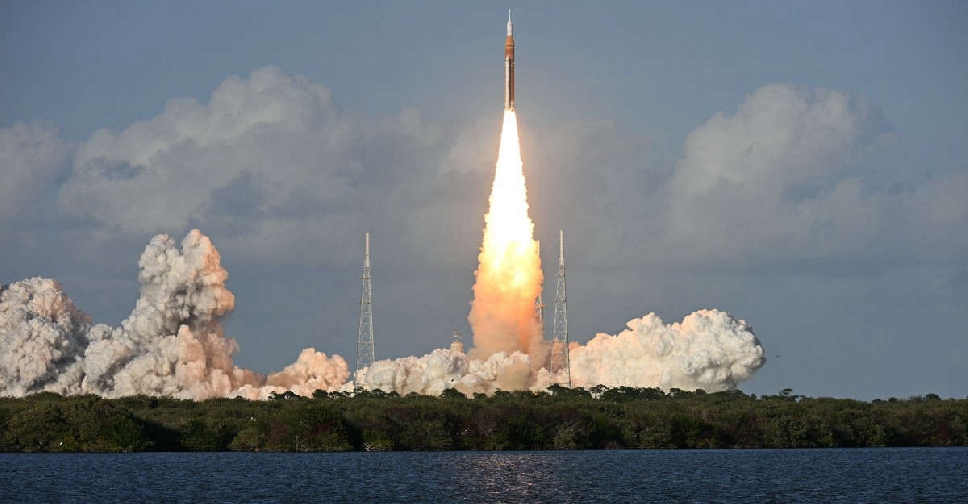
Four astronauts have blasted off from Florida on NASA's Artemis II mission, a high‑stakes 10-day trip around the moon that marks the United States' boldest step yet towards returning humans to the lunar surface this decade before China's first crewed landing.
NASA's Space Launch System (SLS) rocket, topped with its Orion crew capsule, roared to life just before sunset at the agency's Kennedy Space Center to lift its first crew of three US astronauts and a Canadian astronaut off Earth, a thunderous ascent leaving behind a towering column of thick white vapor.
The Artemis II crew of NASA astronauts Reid Wiseman, Victor Glover and Christina Koch and Canadian Space Agency astronaut Jeremy Hansen are poised for a nearly 10-day expedition around the moon and back, taking them deeper into space than humans have ever gone.
Liftoff.
— NASA (@NASA) April 1, 2026
The Artemis II mission launched from @NASAKennedy at 6:35pm ET (2235 UTC), propelling four astronauts on a journey around the Moon.
Artemis II will pave the way for future Moon landings, as well as the next giant leap — astronauts on Mars. pic.twitter.com/ENQA4RTqAc
After nearly three years of training, they are the first group to fly in NASA's Artemis programme, a multibillion-dollar series of missions created in 2017 to build up a long-term US presence on the moon over the next decade and beyond.
The launch was a major milestone more than a decade in the making for the US space agency's SLS rocket, handing its core contractors Boeing and Northrop Grumman long-sought validation that the 30-story-tall system can safely loft humans into space, as NASA increasingly relies on newer, cheaper rockets from Elon Musk's SpaceX and others.
The crew's gumdrop-shaped Orion capsule, built for NASA by Lockheed Martin, will separate from the SLS upper stage 3-1/2 hours into flight in Earth's orbit.
The crew will then take manual control of Orion to test its steering and maneuverability around the detached upper stage, attempting the first of dozens of test objectives planned throughout the mission.
The Artemis II mission is a key early step in the flagship US moon programme, which is targeting its first crewed landing on the lunar surface in 2028 in the Artemis IV mission.
NASA is pressed to achieve that lunar landing - its first since the final Apollo mission in 1972 - as China expands its own lunar programme with a planned astronaut landing as soon as 2030.

 Trump says Iran war goals nearly accomplished in televised address
 One killed as Indonesia earthquake damages buildings
 Florida vice mayor shot dead, husband jailed as suspect
 Tsunami warning issued after powerful Indonesia earthquake
 Trump says US may exit Iran war soon; threatens to quit NATO