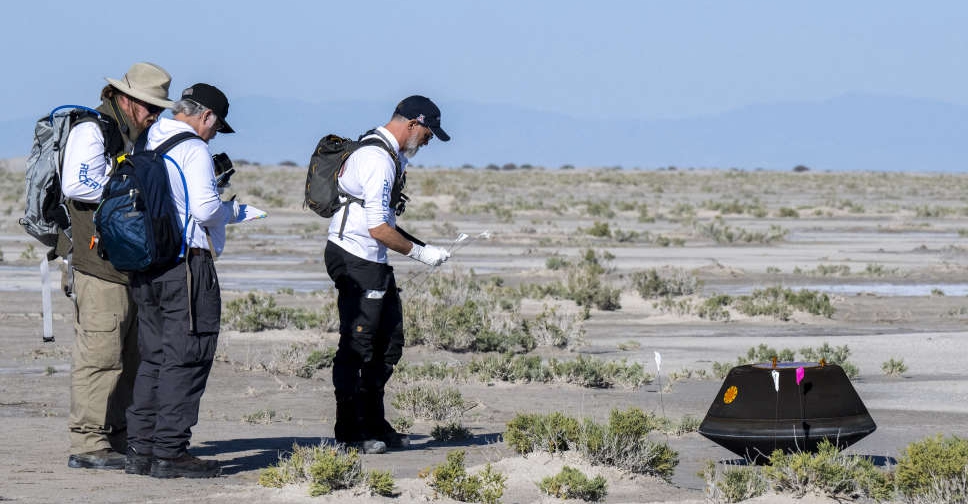
A NASA space capsule carrying the largest soil sample ever scooped up from the surface of an asteroid streaked through Earth's atmosphere on Sunday and parachuted into the Utah desert, delivering the celestial specimen to scientists.
The gumdrop-shaped capsule, released from the robotic spacecraft OSIRIS-REx as the mothership passed within 107,826 km of Earth hours earlier, touched down within a designated landing zone west of Salt Lake City on the US military's vast Utah Test and Training Range.
The final descent and landing, shown on a NASA livestream, capped a six-year joint mission between the US space agency and the University of Arizona. It was only the third asteroid sample, and by far the biggest, ever returned to Earth for analysis, following two similar missions by Japan's space agency ending in 2010 and 2020.
After touchdown, the capsule laid nose-down on the sandy floor of the Utah desert, a red-and-white parachute that slowed its high-speed descent resting just feet away after detaching.
After some doubt about whether a preliminary chute was properly deployed, the main chute unfurled as planned, bringing the capsule to a soft and nearly flawless landing.
"We heard 'main chute detected,' and I literally broke into tears," Dante Lauretta, a University of Arizona scientist who has been involved in the project since its origin and watched the descent from a helicopter, told a press conference.
Tim Prizer, a Lockheed Martin engineer on the project, said, "we touched down as soft as a dove."
A recovery team of scientists and technicians stood by to retrieve the capsule and attempt to keep the sample free of any terrestrial contamination.
The dark capsule and its precious content were flown by helicopter to a "clean room" at the Utah test range for initial examination. On Monday it will be flown on a military transport plane to NASA's Johnson Space Center in Houston, where the canister will be opened on Tuesday in order for the samples to be parceled into smaller specimens promised to some 200 scientists in 60 laboratories around the world.
The main portion of the OSIRIS-REx spacecraft, meanwhile, is expected to sail on to explore Apophis, another near-Earth asteroid.
OSIRIS-REx collected its specimen three years ago from Bennu, a small, carbon-rich asteroid discovered in 1999. The space rock is classified as a "near-Earth object" because it passes relatively close to our planet every six years, though the odds of an impact are considered remote.
Apparently made up of a loose collection of rocks, like a rubble pile, Bennu measures just 500 meters across, making it wider than the Empire State Building is tall but tiny compared with the Chicxulub asteroid that struck Earth some 66 million years ago, wiping out the dinosaurs.


 US military to begin Iran maritime blockade on Monday
 Hungary's Orban concedes landmark election defeat
 Trump vows to blockade Strait of Hormuz after Iran peace talks stumble
 Nigerian airstrike hits market, 200 feared dead
 Russia, Ukraine trade accusations of ceasefire violations