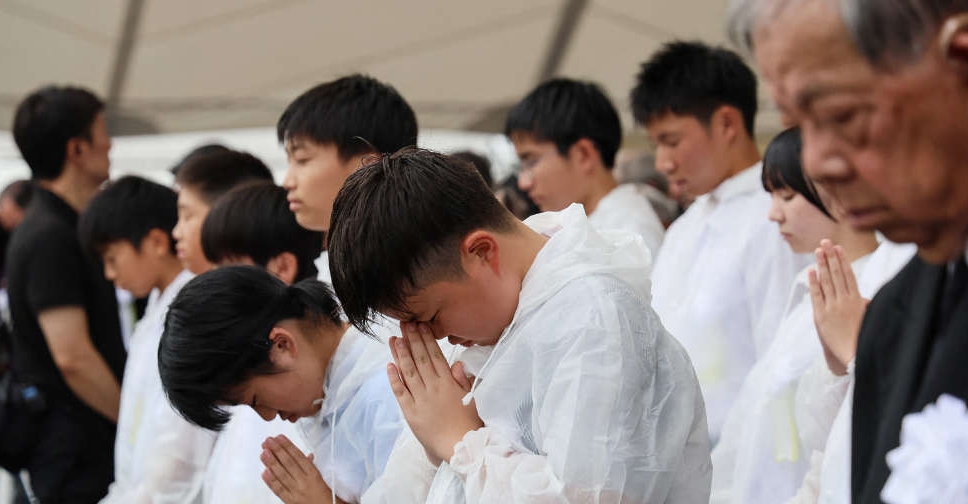
Thousands bowed their heads in prayer in Nagasaki on Saturday to mark the 80th anniversary of the city's atomic bombing, as the mayor warned that current global conflicts could push the world again into nuclear war.
The western Japanese city was levelled on August 9, 1945, when the United States dropped a 10,000-pound plutonium-239 bomb, nicknamed Fat Man, instantly killing some 27,000 of the city's estimated 200,000 people. By the end of 1945, the death toll from acute radiation exposure had reached about 70,000.
Nagasaki's destruction came three days after a US uranium-235 bomb destroyed Hiroshima. Japan surrendered on August 15, ending World War Two.
After a moment of silence at 11:02 am, marking the time of the blast, Mayor Shiro Suzuki called on leaders to return to the principles of the UN Charter and show a concrete path toward abolishing nuclear weapons, warning that delay was "no longer permissible".
"This is a crisis of human survival that is closing in on each and every one of us," Suzuki told the crowd, estimated by Japanese media at 2,700.
He quoted the testimony of a survivor to illustrate the reality of a nuclear attack: "Around me were people whose eyeballs had popped out...Bodies were strewn about like stones."
"Is it not this 'global citizen' perspective that will serve as the driving force behind stitching back together our fragmented world?" Suzuki asked, calling for a solution based on mutual understanding and solidarity.
The US military is believed to have chosen Nagasaki as a target due to its significance as a major industrial and port city. The city's geographical features, including its hilly terrain, were also thought to concentrate the blast.
Representatives from 95 countries and territories, including nuclear superpower the United States, and Israel - which neither confirms nor denies having nuclear weapons - attended the annual ceremony at the Nagasaki Peace Memorial Park for the milestone year.
Russia, which possesses the world's largest nuclear stockpile, was also represented.
Daiji Kawanaka, a 14-year-old tourist from Osaka, echoed the mayor's sentiments.
"I truly believe a tragedy like this must never be repeated," he told Reuters, saying the anniversary prompts conversations about peace even among his young peers. "We can only pledge to take the initiative ourselves in making a step toward peace."
Japan's leading organisation of A-bomb survivors, Nihon Hidankyo, won the Nobel Peace Prize last year for campaigning for a world without nuclear weapons.
Survivors, known as hibakusha, continue to suffer the effects from radiation and social discrimination. With their numbers falling below 100,000 for the first time this year, their stories fuel ongoing efforts to advocate for a nuclear-free world.
Japan, the only country to have suffered nuclear attacks, has stated its commitment to nuclear disarmament but is not a signatory or observer of the UN treaty to ban nuclear weapons.

 US-Iran peace talks end without agreement, delegations leave Pakistan
 At least 30 dead in stampede at Haiti’s historic Laferriere Citadel
 Cyclone lashes New Zealand's North Island, hundreds evacuated
 US-Iran talks pause for now, disagreements remain
 Costa Rica receives first group of deported migrants under agreement with US