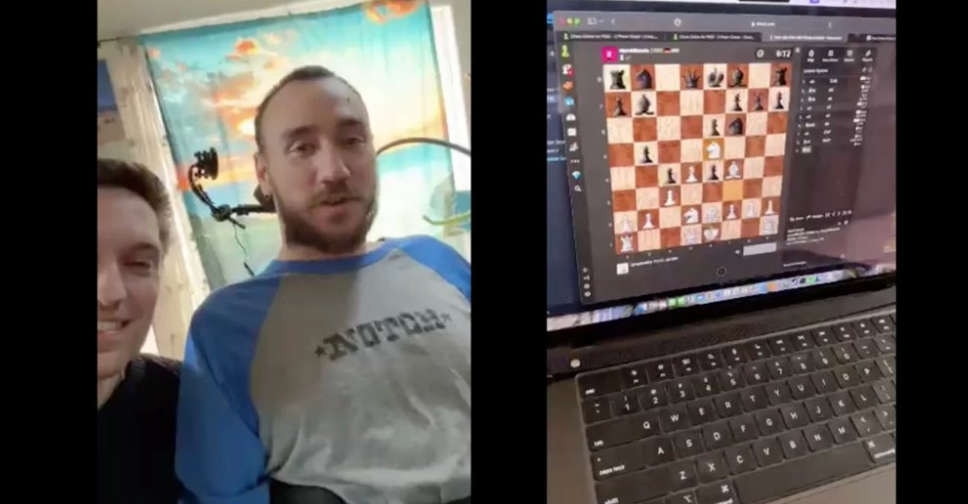
Elon Musk's brain-chip startup Neuralink, on Wednesday, live-streamed its first patient implanted with a chip using his mind to play online chess.
Noland Arbaugh, the 29-year-old patient who was paralysed below the shoulder after a diving accident, played chess on his laptop and moved the cursor using the Neuralink device. The implant seeks to enable people to control a computer cursor or keyboard using only their thoughts.
Arbaugh had received an implant from the company in January and could control a computer mouse using his thoughts, Musk said last month.
"The surgery was super easy," Arbaugh said in the video streamed on Musk's social media platform X, referring to the implant procedure. "I literally was released from the hospital a day later. I have no cognitive impairments.
"I had basically given up playing that game," Arbaugh said, referring to the game Civilization VI, "you all (Neuralink) gave me the ability to do that again and played for 8 hours straight."
Elaborating on his experience with the new technology, Arbaugh said that it is "not perfect" and they "have run into some issues".
"I don't want people to think that this is the end of the journey, there's still a lot of work to be done, but it has already changed my life," he added.
Kip Ludwig, former program director for neural engineering at the US National Institutes of Health, said what Neuralink showed was not a "breakthrough".
"It is still in the very early days post-implantation, and there is a lot of learning on both the Neuralink side and the subject's side to maximise the amount of information for control that can be achieved," he said.
Even so, Ludwig said it was a positive development for the patient that they have been able to interface with a computer in a way they were not able to before the implant. "It's certainly a good starting point," he said.
Last month, Reuters reported that the US Food and Drug Administration inspectors found problems with record keeping and quality controls for animal experiments at Elon Musk's Neuralink, less than a month after the startup said it was cleared to test its brain implants in humans. Neuralink did not respond then to questions about the FDA's inspection.
BREAKING: The first human Neuralink patient moving cursor and playing chess using just his brain. pic.twitter.com/cVztlB0hfC
— DogeDesigner (@cb_doge) March 20, 2024

 India's 'cockroach' movement founder arrested after detention, media reports say
 Teacher and armed parent teamed up to stop Oregon school shooter, police say
 Saudi Arabia intercepts 3 missiles, 3 drones targeting different regions
 White House press secretary Zacharia fired in less than a week after facing criticism
 Indian police detain 'cockroach' movement founder Dipke ahead of protest