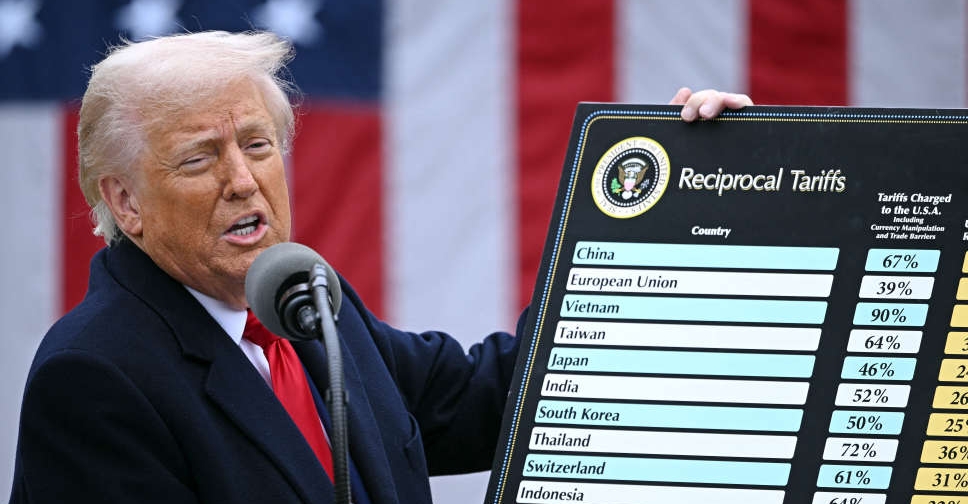
A divided US appeals court ruled on Friday that most of Donald Trump's tariffs are illegal, undercutting the Republican president's use of the levies as a key international economic policy tool.
The court allowed the tariffs to remain in place through October 14 to give the Trump administration a chance to file an appeal with the US Supreme Court.
The decision comes as a legal fight over the independence of the Federal Reserve also seems bound for the Supreme Court, setting up an unprecedented legal showdown this year over Trump's entire economic policy.
Trump has made tariffs a pillar of US foreign policy in his second term, using them to exert political pressure and renegotiate trade deals with countries that export goods to the United States.
The tariffs have given the Trump administration leverage to extract economic concessions from trading partners but have also increased volatility in financial markets.
Trump lamented the decision by what he called a "highly partisan" court, posting on Truth Social: "If these Tariffs ever went away, it would be a total disaster for the country". He nonetheless predicted a reversal, saying he expected tariffs to benefit the country "with the help of the Supreme Court".
The 7-4 decision from the US Court of Appeals for the Federal Circuit in Washington, D.C., addressed the legality of what Trump calls "reciprocal" tariffs imposed as part of his trade war in April, as well as a separate set of tariffs imposed in February against China, Canada and Mexico.
Democratic presidents appointed six judges in the majority and two judges who dissented, while Republican presidents appointed one judge in the majority and two dissenters.
The court's decision does not impact tariffs issued under other legal authority, such as Trump's tariffs on steel and aluminum imports.
'UNUSUAL AND EXTRAORDINARY'
Trump justified both sets of tariffs - as well as more recent levies - under the International Emergency Economic Powers Act. IEEPA gives the president the power to address "unusual and extraordinary" threats during national emergencies.
"The statute bestows significant authority on the President to undertake a number of actions in response to a declared national emergency, but none of these actions explicitly include the power to impose tariffs, duties or the like, or the power to tax," the court said.
"It seems unlikely that Congress intended, in enacting IEEPA, to depart from its past practice and grant the President unlimited authority to impose tariffs."
The 1977 law had historically been used for imposing sanctions on enemies or freezing their assets. Trump, the first president to use IEEPA to impose tariffs, says the measures were justified given trade imbalances, declining US manufacturing power and the cross-border flow of drugs.
Trump's Department of Justice has argued that the law allows tariffs under emergency provisions that authorise a president to "regulate" imports or block them completely.
Trump declared a national emergency in April over the fact that the US imports more than it exports, as the nation has done for decades. Trump said the persistent trade deficit was undermining US manufacturing capability and military readiness.
Trump said the February tariffs against China, Canada and Mexico were appropriate because those countries were not doing enough to stop illegal fentanyl from crossing US borders, an assertion the countries have denied.

 US military to begin Iran maritime blockade on Monday
 Hungary's Orban concedes landmark election defeat
 Trump vows to blockade Strait of Hormuz after Iran peace talks stumble
 Nigerian airstrike hits market, 200 feared dead
 Russia, Ukraine trade accusations of ceasefire violations