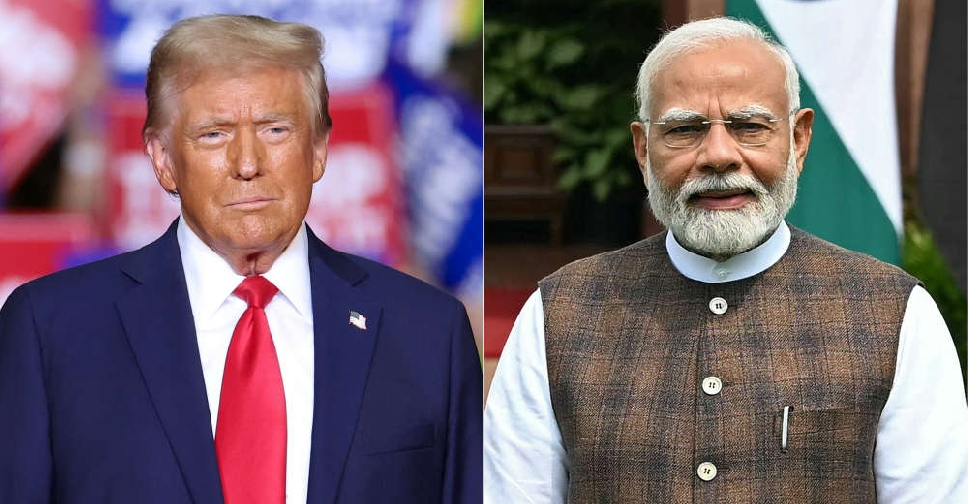
New Delhi has put on hold its plans to procure new U.S. weapons and aircraft, according to three Indian officials familiar with the matter, in India's first concrete sign of discontent after tariffs imposed on its exports by President Donald Trump dragged ties to their lowest level in decades.
India had been planning to send Defence Minister Rajnath Singh to Washington in the coming weeks for an announcement on some of the purchases, but that trip has been cancelled, two of the people said.
Trump on August 6 imposed an additional 25 per cent tariff on Indian goods as punishment for Delhi's purchases of Russian oil, which he said meant the country was funding Russia's invasion of Ukraine. That raised the total duty on Indian exports to 50 per cent - among the highest of any U.S. trading partner.
The president has a history of rapidly reversing himself on tariffs and India has said it remains actively engaged in discussions with Washington.
One of the people said the defence purchases could go ahead once India had clarity on tariffs and the direction of bilateral ties, but "just not as soon as they were expected to."
Written instructions had not been given to pause the purchases, another official said, indicating that Delhi had the option to quickly reverse course, though there was "no forward movement at least for now."
Post publication of this story, India’s government issued a statement it attributed to a Ministry of Defence source describing news reports of a pause in the talks as "false and fabricated." The statement also said procurement was progressing as per "extant procedures."
Delhi, which has forged a close partnership with America in recent years, has said it is being unfairly targeted and that Washington and its European allies continue to trade with Moscow when it is in their interest.
Reuters is reporting for the first time that discussions on India's purchases of Stryker combat vehicles made by General Dynamics Land Systems and Javelin anti-tank missiles developed by Raytheon and Lockheed Martin LMT.N have been paused due to the tariffs.
Trump and Indian Prime Minister Narendra Modi had in February announced plans to pursue procurement and joint production of those items.
Singh had also been planning to announce the purchase of six Boeing P8I reconnaissance aircraft and support systems for the Indian Navy during his now-cancelled trip, two of the people said. Talks over procuring the aircraft in a proposed $3.6 billion deal were at an advanced stage, according to the officials.
Boeing, Lockheed Martin and General Dynamics referred queries to the Indian and U.S. governments. Raytheon did not return a request for comment.
India's deepening security relationship with the U.S., which is fuelled by their shared strategic rivalry with China, was heralded by many U.S. analysts as one of the key areas of foreign-policy progress in the first Trump administration.
Delhi is the world's second-largest arms importer and Russia has traditionally been its top supplier. India has in recent years however, shifted to importing from Western powers like France, Israel and the U.S., according to the Stockholm International Peace Research Institute think-tank.
The shift in suppliers was driven partly by constraints on Russia's ability to export arms, which it is utilizing heavily in its invasion of Ukraine. Some Russian weapons have also performed poorly in the battlefield, according to Western analysts.

 Trump vows to blockade Strait of Hormuz after Iran peace talks stumble
 Nigerian airstrike hits market, 200 feared dead
 Russia, Ukraine trade accusations of ceasefire violations
 At least 30 dead in stampede at Haiti’s historic Laferriere Citadel
 Cyclone lashes New Zealand's North Island, hundreds evacuated