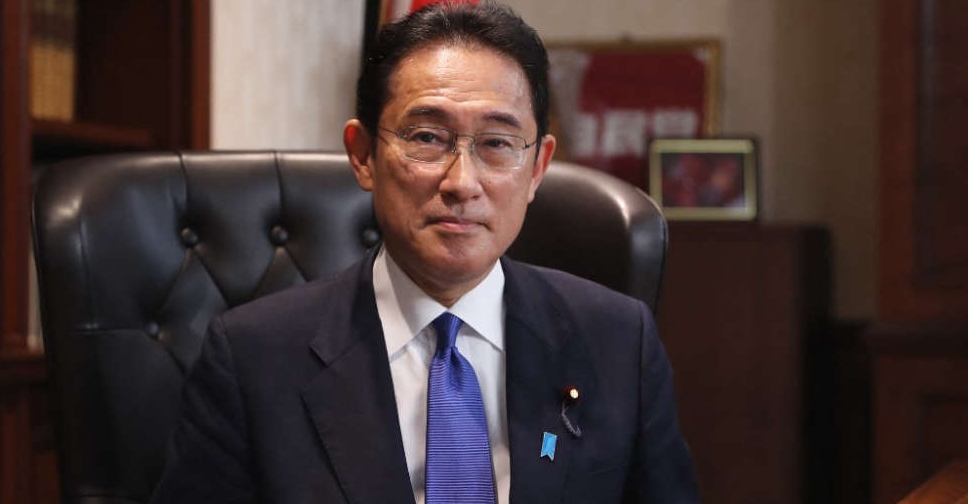
Japan's new prime minister, Fumio Kishida, exchanged fist bumps with lawmakers after he was formally elected by parliament on Monday, as public broadcaster NHK said he was set to dissolve the body next week and call an election for October 31.
The surprise move, amid widespread expectations for a poll in November, appears to be aimed at exploiting a traditional honeymoon period accorded to new governments and a sharp drop in the number of coronavirus infections.
Outgoing prime minister Yoshihide Suga enjoyed support ratings of about 70 per cent soon after taking office about a year ago, but was pummelled by criticism of his handling of the pandemic, leading him to make way for a new face to lead the ruling Liberal Democratic Party (LDP) through the election.
Kishida, 64, a former foreign minister with an image as a low-key consensus builder, beat out three contenders last week to lead the party and will become prime minister as it has a majority in parliament.
He is set to dissolve parliament on October 14 and will announce the election in his first news conference as prime minister later on Monday, NHK television said.
The ruling party's new secretary-general, Akira Amari, told reporters that while he had not heard anything for certain, he believed Kishida would move in that direction.
"Kishida's not wasting any time at all," Tobias Harris, a senior fellow of the Center for American Progress, said on Twitter.
"October 31 puts the opposition on its heels, takes advantage of a honeymoon in the polls, plus a better chance of lower case numbers."
Harris added, "If he wins comfortably in the general election and can hold things together well enough to win the upper house elections next year, he'll have up to three years without an election."
Kishida's poll decision was probably influenced by not wanting to repeat a mistake made by Suga, who did not call an election when his backing was still strong, analysts said.
"I believe he aims to hold the election before the general atmosphere (towards the new cabinet) turns cold," said Zentaro Kamei, a senior fellow at the PHP Institute.
ABE'S SHADOW
Later on Monday, Kishida is set to unveil a cabinet featuring allies of former prime minister Shinzo Abe, so ensuring the influence of the latter's conservative base.
Of the 20 posts, 13 will be filled by people with no prior cabinet experience, in line with Kishida's pledge to give chances to new people, but the majority of heavyweight jobs will go to allies of Abe, or outgoing finance minister Taro Aso.
"He won the election with the support of Abe and Aso, so now it's time for him to return the favour, it's not the time for him to cut them off," said political analyst Atsuo Ito, adding that Kishida tended to rate safety over bold action.
One of those closest to Abe is Amari, who has promised a big extra budget after the election, told reporters on Monday it would need to include steps to ameliorate social divisions and COVID-19.
"It's not just Japan, but the divisions in society have increased during the coronavirus pandemic and many people are worried," Amari said.
"So we need to empathise with the people and share their pain and our leader needs to show the path to unite society and to make it one again."
Set to replace Aso is his low-profile brother-in-law, Shunichi Suzuki, who is viewed as likely to continue the government's policy of tempering growth spending with fiscal reform.
Other jobs destined for Abe allies are the trade and industry portfolio, to be held by current education minister Koichi Hagiuda, who is close to Abe.
Defence Minister Nobuo Kishi, who is Abe's brother, will retain his position, as will Foreign Minister Toshimitsu Motegi.
There are three women in the line-up, one more than Suga had, but none holds a heavyweight portfolio.


 US-Iran peace talks end without agreement, delegations leave Pakistan
 Russia, Ukraine trade accusations of ceasefire violations
 At least 30 dead in stampede at Haiti’s historic Laferriere Citadel
 Cyclone lashes New Zealand's North Island, hundreds evacuated
 US-Iran talks pause for now, disagreements remain