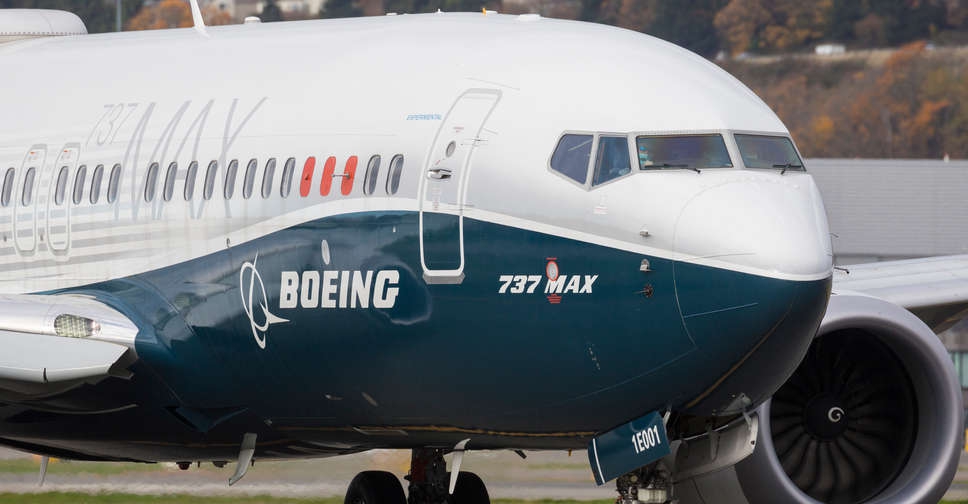
The US Federal Aviation Administration (FAA) tightened pressure on Boeing by barring the troubled planemaker from expanding production of its best-selling 737 MAX narrowbody planes, following "unacceptable" quality issues.
The unprecedented decision looked set to deepen turmoil at Boeing even as the FAA also agreed to allow the 737 MAX 9, which was grounded after a mid-air blowout on an Alaska Airlines jet on January 5, to resume flying once inspections were completed.
The ability to resume flying was a relief to US operators Alaska Airlines and United Airlines, which had been forced to cancel thousands of flights and aim to begin returning the planes to service on Friday and Sunday, respectively.
But the FAA decision to keep Boeing from expanding production will have wide-ranging effects across the industry.
Boeing is seeking to increase production of its single-aisle 737 MAX family to keep pace with demand and close a gap in the jet market with European planemaker Airbus.
Analysts have expressed concerns that extra scrutiny of Boeing factories following the MAX 9 door plug blowout would temper production increases for the smaller and more widely sold MAX 8, a key source of cash for Boeing and many suppliers.
"We will not agree to any request from Boeing for an expansion in production or approve additional production lines for the 737 MAX until we are satisfied that the quality control issues uncovered during this process are resolved," FAA Administrator Mike Whitaker said.
"The quality assurance issues we have seen are unacceptable."
Clarifying the order, the FAA subsequently told Reuters: "That means Boeing can continue producing at the current monthly rate, but they cannot increase that rate."
Boeing said it would continue to cooperate "fully and transparently" with the FAA and follow the agency's direction as it took action to strengthen safety and quality.
The FAA offered no estimate of how long the limitation would last and did not specify the number of planes Boeing can produce each month.
In October, Boeing CEO Dave Calhoun said it planned to reach production of 38 MAX planes per month by the end of 2023.
Boeing's latest 737 master schedule, which sets the production pace for suppliers, calls for production to rise to 42 jets per month in February, 47.2 in August, 52.5 by February 2025 and 57.7 in October 2025, Reuters reported in December.
However, Boeing's own production pace can lag the supplier master schedule.
The FAA's decision could impact plans to stand up a new 737 MAX line in Everett, Washington, by mid-year 2024, following the end of production of Boeing's iconic 747 in the massive plant.
The line, set to be the fourth 737 line overall and the first outside Renton, is needed to meet strong demand.
Once accused of being too soft on Boeing, the FAA has toughened oversight since earlier MAX crashes led to a worldwide grounding, but Wednesday's intervention opens new territory, experts said.

 US military to begin Iran maritime blockade on Monday
 Orban ousted after 16 years as Hungarians flock to pro-EU rival
 Trump vows to blockade Strait of Hormuz after Iran peace talks stumble
 Nigerian airstrike hits market, 200 feared dead
 Russia, Ukraine trade accusations of ceasefire violations