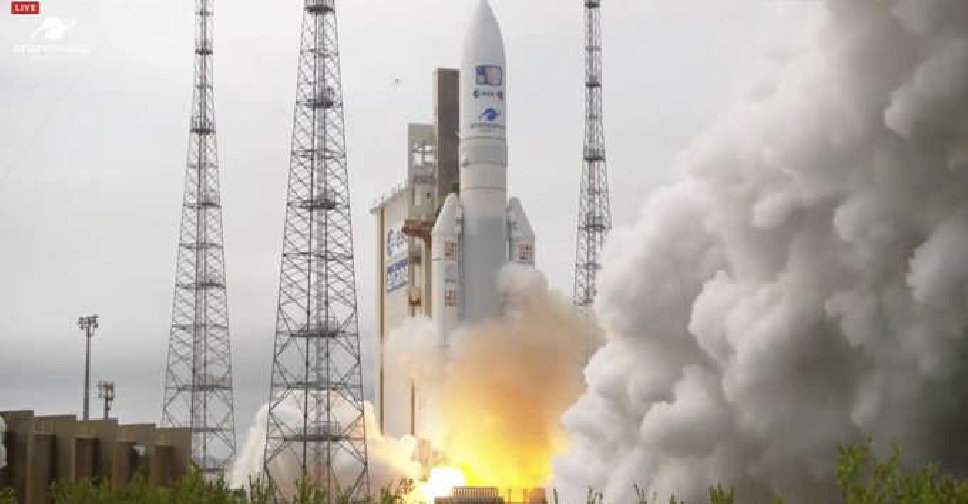
The European Space Agency's JUICE space probe successfully launched Friday on a mission to discover whether Jupiter's icy moons are capable of hosting extraterrestrial life in their vast, hidden oceans.
The launch on an Ariane 5 rocket from Europe's spaceport in Kourou, French Guiana came after a previous attempt on Thursday was called off due to the risk of lightning.
Despite cloudy skies, the rocket took off as planned at 9.14am local time (1214 GMT) on Friday, as guests including Belgium's King Philippe watched from the Guiana Space Centre.
A little under half an hour later, the uncrewed six-tonne spacecraft separated from the rocket at an altitude of 1,500 kilometres, which prompted an outbreak of applause at the centre.
Stephane Israel, the CEO of French firm Arianespace in charge of the rocket, said the launch was "a success".
After a few tense minutes, ground control were relieved to receive the first signal from spacecraft.
The spacecraft then began unfurling its array of solar panels, which are a record 85 square metres, the size of a basketball court. It will need all the energy it can get near Jupiter, where sunlight is 25 times weaker than on Earth.
Carole Larigauderie, JUICE project head at France's space agency CNES, said the launch the beginning of a long journey which will "not be at all calm".
The Jupiter Icy Moons Explorer (JUICE) will take a long and winding path to the gas giant, which is 628 million kilometres from Earth.
It will use several gravitational boosts along the way, first by doing a fly-by of Earth and the Moon, then by sling-shotting around Venus in 2025 before swinging past Earth again in 2029.
When the probe finally enters Jupiter's orbit in July 2031, its 10 scientific instruments will analyse the Solar System's largest planet as well as its three icy moons Europa, Ganymede and Callisto.
The moons were first discovered by astronomer Galileo Galilei more than 400 years ago, but were long ignored as potential candidates for hosting life.
However, the discovery of huge oceans of liquid water -- the main ingredient for life as we know it -- kilometres beneath their icy shells has made Ganymede and Europa prime candidates to potentially host life in our celestial backyard.
JUICE will focus on Ganymede, the Solar System's largest moon and the only one that has its own magnetic field, which protects it from radiation.
In 2034, JUICE will slide into Ganymede's orbit, the first time a spacecraft will have done so around a moon other than our own.
NASA's Europa Clipper mission, which is scheduled to launch in October 2024, will focus on Ganymede's sibling Europa.
Neither mission will be able to directly detect the existence of alien life, but instead hope to establish whether the moons have the right conditions to harbour life.
LIFTOFF of @ariane5 #VA260 with @ESA_JUICE on 14 April 2023: #DestinationJupiter! pic.twitter.com/cV6YDjJXZD
— European Space Agency (@esa) April 14, 2023


 US military to begin Iran maritime blockade on Monday
 Hungary's Orban concedes landmark election defeat
 Trump vows to blockade Strait of Hormuz after Iran peace talks stumble
 Nigerian airstrike hits market, 200 feared dead
 Russia, Ukraine trade accusations of ceasefire violations