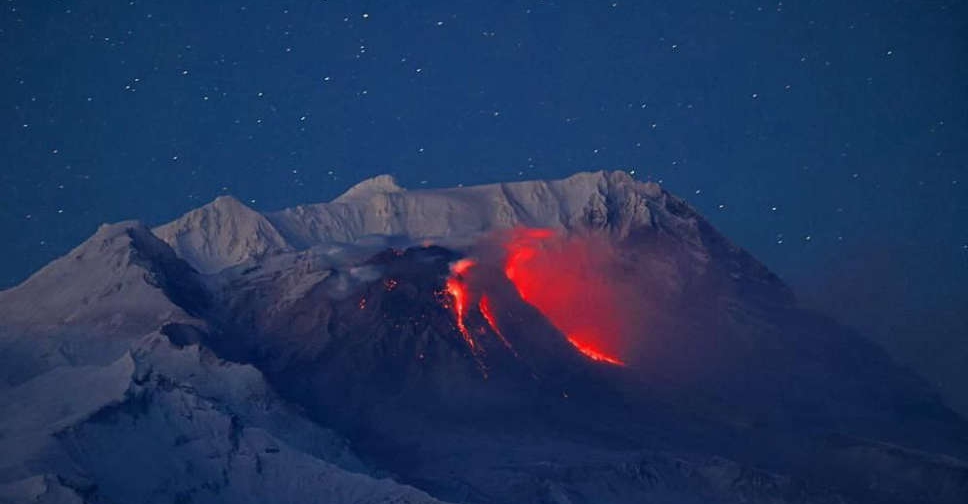
One of Russia's most active volcanoes erupted on Tuesday shooting a vast cloud of ash far up into the sky and smothering villages in drifts of grey volcanic dust, triggering an aviation warning around Russia's far eastern Kamchatka Peninsula.
The Shiveluch volcano erupted just after midnight reaching a crescendo about six hours later, spewing out an ash cloud over an area of 108,000 square kilometres, according to the Kamchatka Branch of the Russian Academy of Sciences' Geophysical Survey.
Lava flows tumbled from the volcano, melting snow and prompting a warning of mud flows along a nearby highway while villages were carpeted in drifts of grey ash as deep as 8.5 centimeters, the deepest in 60 years.
"The ash reached 20 kilometres high, the ash cloud moved westwards and there was a very strong fall of ash on nearby villages," said Danila Chebrov, director of the Kamchatka branch of the Geophysical Survey.
"The volcano was preparing for this for at least a year... and the process is continuing though it has calmed a little now," Chebrov said.
He said the volcano would probably calm now, but that further major ash clouds could not be excluded. He said lava flows should not reach local villages.
The Kamchatka Volcanic Eruption Response Team (KVERT) issued a red notice for aviation, saying "ongoing activity could affect international and low-flying aircraft".
Some schools in the Kamchatka peninsula, about 6,800 km east of Moscow, were closed and residents ordered to stay indoors, head of the Ust-Kamchatsky municipal region Oleg Bondarenko said in a Telegram post.
"Because what I have just seen here with my own eyes, it will be impossible for children to go to school, and in general, the presence of children here is questionable," Bondarenko said.
He said residents' power had been restored and that drinking water was being supplied.
One of Kamchatka's largest and most active volcanoes, Shiveluch has had an estimated 60 substantial eruptions in the past 10,000 years, the last major one being in 2007.
It has two main parts, the smaller of which - Young Shiveluch - scientists have reported as being extremely active in recent months, with a peak of 2,800 metres that protrudes out of the 3,283 metre-high Old Shiveluch.
Scientists posted pictures of the ash cloud billowing swiftly over the forests and rivers of the far east and of villages covered in ash. One posted a picture of the depth of the ash fall - more than 8 centimetres deep.


 Trump vows to blockade Strait of Hormuz after Iran peace talks stumble
 Nigerian airstrike hits market, 200 feared dead
 Russia, Ukraine trade accusations of ceasefire violations
 At least 30 dead in stampede at Haiti’s historic Laferriere Citadel
 Cyclone lashes New Zealand's North Island, hundreds evacuated