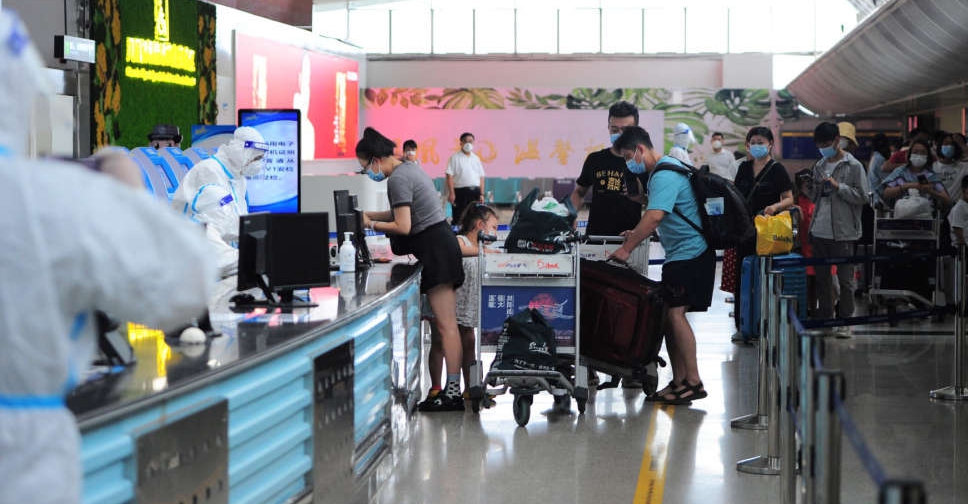
China will stop requiring inbound travellers to go into quarantine starting from January 8, the National Health Commission said on Monday.
It's another major step towards easing curbs on its borders, which have been largely shut since 2020.
China's management of COVID-19 will also be downgraded to the less strict Category B from the current top-level Category A, the health authority said in a statement, as the disease has become less virulent and will gradually evolve into a common respiratory infection.
Three years of zero-tolerance measures, from shuttered borders to frequent lockdowns, have battered China's economy, fuelling last month the mainland's biggest show of public discontent since President Xi Jinping took power in 2012.
But China made an abrupt policy U-turn this month, dropping nearly all of its domestic COVID curbs in a move that has left hospitals across the country scrambling to cope with a nationwide wave of infections.
Strict requirements on inbound travellers had remained in place, including five days of mandatory quarantine at a government-supervised facility and three more of isolation at home.
That restriction and one on the number of passengers on international flights will be removed from January 8.
Travellers entering China will still have to undergo PCR testing 48 hours before departure, however, the health authority said.
Arrangements for foreigners to come to China, such as for work and business will be improved and the necessary visas will also be facilitated, the authority said.
But passenger entry and exit at sea and land ports will gradually resume, while the outbound travel of Chinese nationals will be restored "in an orderly manner", it added.
Since January 2020, China had classified COVID-19 as a Category B infectious disease but managed it under Category A protocols that cover diseases such as bubonic plague and cholera, giving local authorities the power to quarantine patients and their close contacts and lock down regions.
While China downgrades its management of the new coronavirus, the National Health Commission said epidemic prevention and control protocols at key institutions such as elderly care institutions will be strengthened.
If an outbreak becomes severe, the institution will adopt so-called "closed management" to prevent the spread of infections, the authority said.
China will also further increase the vaccination rate among the elderly, and promote second doses among people at high risk of severe illness.
China is the last major country to move toward treating COVID as endemic. Its containment measures had slowed the $17 trillion economy to its lowest growth rate in nearly half a century, disrupting global supply chains and trade.


 US military to begin Iran maritime blockade on Monday
 Hungary's Orban concedes landmark election defeat
 Trump vows to blockade Strait of Hormuz after Iran peace talks stumble
 Nigerian airstrike hits market, 200 feared dead
 Russia, Ukraine trade accusations of ceasefire violations