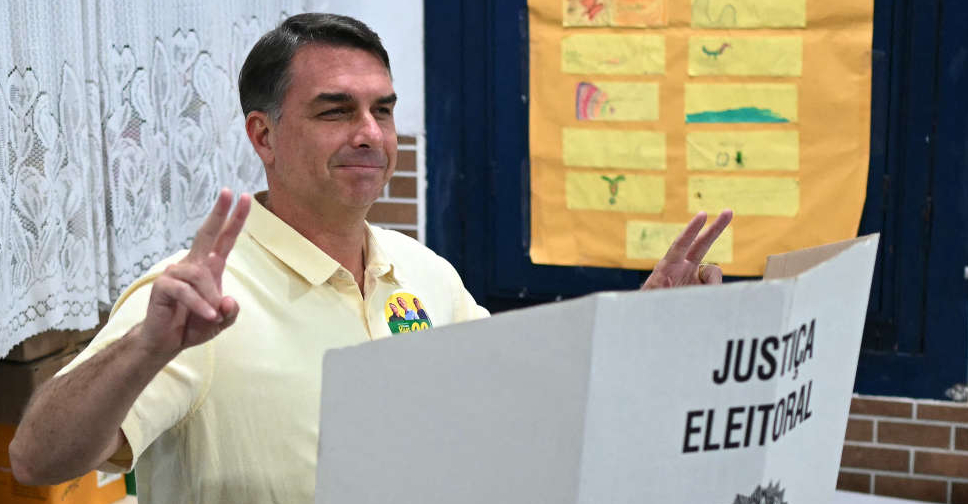
Right-wing Brazilian Senator Flavio Bolsonaro will face leftist President Luiz Inacio Lula da Silva in a runoff of the presidential election later this month, after he exceeded expectations in Sunday's first-round vote with a slight lead over the incumbent.
The election, which centered around the cost of living, corruption and insecurity in Brazilians' daily lives, follows a string of wins across Latin America by right-wing parties aligned with US President Donald Trump.
Bolsonaro's stronger-than-expected performance, at 47 per cent of votes versus Lula's 45 per cent, is expected to buoy his campaign and may bolster Brazil's currency and stock market, which have risen on the prospects of the business-friendly challenger. Private surveys in the run-up to the election had forecast Lula leading the first-round vote by around 3 percentage points.
"Brazil wants change, and I am very happy with the results," Bolsonaro told reporters in Brasilia after nearly all tallies were reported, heralding "the end of the era of (Lula's) Workers' Party."
The senator, son of right-wing former President Jair Bolsonaro, who is serving a 27-year sentence for plotting a coup after losing the 2022 election, now heads to an October 25 showdown with the leftist Lula.
Addressing a crowd at a hotel in Sao Paulo, Lula said he had been convinced he would win the election in the first round.
"Starting tomorrow, we begin a new campaign," he said, promising to show voters what he had accomplished as president.
Despite growing worries over Brazil's public finances and sluggish economic growth, the campaign offered meager policy debate, as both leading candidates skipped the major TV debates.
ECONOMIC HEADWINDS
Despite Brazil's falling inequality and unemployment, Lula has struggled to win over voters grappling with the high cost of living, heavy household debt and the threat of crime and more pervasive gang activity.
Bolsonaro has sought to capitalize on cost-of-living concerns, while Lula moved to ban online gambling and, as the race tightened, expanded welfare and proposed fresh debt relief for families.
Rising spending and public debt above 82 per cent of GDP have stoked fiscal concerns that Brazil's next president will need to address. The government lowered its economic growth forecasts for this year and next to 2.0 per cent and 2.3 per cent, respectively.
"I voted for Brazil to start growing again," said Marciano de Souza e Silva, a 52-year-old public servant in Brasilia who voted for Flavio.
OVERSHADOWED DEBATE
Scandals and fears of foreign interference ahead of the vote largely overshadowed policy debates during the campaign.
Controversy surrounding the now-defunct Banco Master engulfed much of Brazil's political class after Daniel Vorcaro, who ran the bank, was arrested earlier this year and accused of a multibillion-dollar fraud scheme, which he denies.
A federal police investigation has looked into the banker's ties to figures across Brazil's political elite, including Bolsonaro, who is being investigated for suspected money laundering that police have tied to the case. Bolsonaro has denied wrongdoing.
Throughout the campaign, Lula's allies have warned that the Trump administration might refuse to recognize election results if he wins, pointing to an aborted effort to send US officials to Brazil.
Trump has not formally endorsed a candidate, though he hosted Senator Bolsonaro at the White House and praised him publicly.
Reuters reported on Wednesday that Brazilian intelligence officials briefed a French and German delegation on alleged US and Russian interference before the election. The US has rejected claims of interference in Brazil's affairs.
On Sunday afternoon, Brazil's electoral court chief Kassio Nunes Marques said the election was running smoothly.

 Omani court sentences two tourists for sitting on nesting turtles
 US Coast Guard suspends search for people on crashed medical aircraft
 Merz unveils fresh military aid in Kyiv, says Germany won't be intimidated
 Protests demanding Indian election chief resigns escalate
 US Coast Guard finds debris from missing medical aircraft off Nantucket