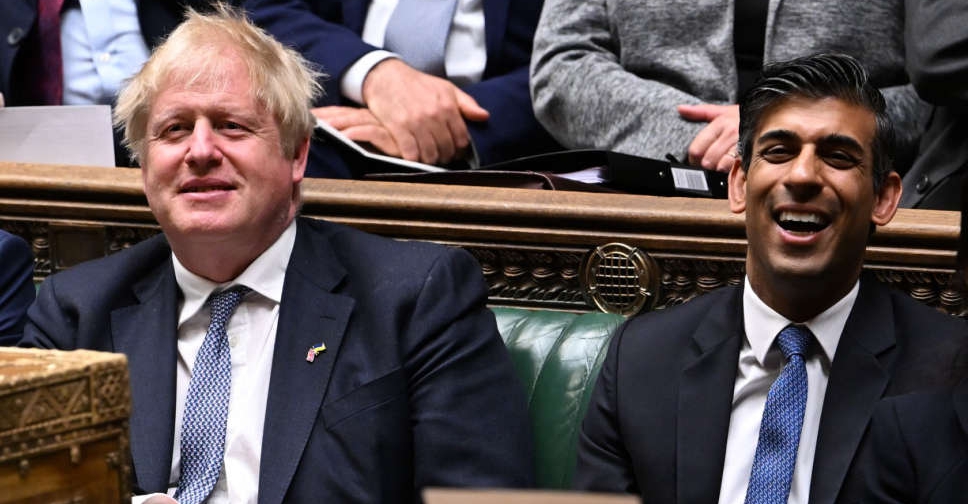
Boris Johnson and his former finance minister Rishi Sunak were leading the potential contenders to replace British Prime Minister Liz Truss on Friday, with candidates canvassing support to become Conservative Party leader in a fast-tracked contest.
After Truss quit on Thursday, ending her six weeks in power, those who want to replace her were trying to find the 100 votes from Conservative lawmakers needed to run in a contest that the party hopes will reset its ailing fortunes.
With the Conservatives all but facing a wipeout in the next national election, according to opinion polls, the race is on to become the fifth British premier in six years.
The winner will be announced on either Monday or Friday next week.
In what would be an extraordinary comeback, Johnson, who was ousted by lawmakers just over three months ago, was running high up the ranks alongside Sunak to be crowned the next prime minister.
"I think he's got that proven track record to turn around things. He can turn it around again. And I'm sure my colleagues hear that message loud and clear," Conservative lawmaker Paul Bristow said of Johnson on LBC radio.
"Boris Johnson can win the next general election," he said.
Johnson, who left office comparing himself to a Roman dictator brought into power twice to fend off crises, might face difficulty in reaching the 100 votes after his three-year tenure was blighted by scandals and allegations of misconduct.
One of his former advisers, who no longer speaks to Johnson and requested not to be identified, said he was unlikely to reach the target, having alienated dozens of Conservatives during his scandal-ridden tenure.
The Financial Times newspaper, which called for a new election, said a Boris comeback would be "farcical".
Will Walden, who also previously worked for Johnson, said the former prime minister was returning from holiday and was taking soundings.
"The country needs a grown-up, serious leader. Boris had his chance, let's move on. I suspect that is not what the Tory party will do, they may well re-elect him," he told the BBC.
Business minister Jacob Rees-Mogg said he was backing Boris, tweeting his support with the hashtag '#Borisorbust'.
The contest began on Thursday, hours after Truss stood in front of her Downing Street office to say she could not go on.
Sunak, the former Goldman Sachs analyst who became finance minister just as the COVID-19 pandemic arrived in Europe and was runner-up to Truss in the previous leadership contest this summer, is favourite with bookmakers, followed by Johnson.
Running in third is Penny Mordaunt, a former defence minister popular with party members. None have formally declared their candidacy.
TRUSS QUITS
Truss quit following the shortest, most chaotic tenure of any British prime minister after her economic programme shattered the country's reputation for financial stability and left many people poorer.
Truss said she could no longer carry out her programme after her economic plan roiled markets, forcing a U-turn under a new finance minister after she sacked her closest political ally.
The sight on Thursday of yet another unpopular prime minister making a resignation speech in Downing Street - and the start of a new leadership race - underscores how volatile British politics has become since the 2016 Brexit vote.
Some Conservative lawmakers hope the race to replace her will be quick and simple, urging the hopefuls to coalesce around one candidate to reduce the pain of another bruising contest.
Sunak, proven right in his warnings that Truss's fiscal plan threatened the economy, remains deeply unpopular with some party members after he helped to trigger the summer rebellion against Johnson.
Mordaunt is seen as a fresh pair of hands largely untainted by earlier administrations. But she is also untested and, so far, she is lagging Sunak and Johnson in getting backers.
The next leader faces a difficult economic situation, inheriting an economy heading for recession, inflation topping 10 per cent, rising interest rates, labour shortages, and a cost-of-living squeeze.
Data published on Friday showed British shoppers reined in their spending sharply and put their confidence levels close to record lows while worse-than-expected public borrowing figures underscored the economic challenges ahead.
Whoever takes over the party also has a mountain to climb to try to restore or renew the reputation of the Conservative Party, which holds a big majority in parliament and need not call a nationwide election for another two years.
"Whether or not a change of leader is going to be sufficient to make the Conservatives actually electorally credible is certainly highly debatable," political scientist John Curtice told LBC.
"The problem for the Conservatives is that the brand of them as a party that can mind the economy ... has now been very, very badly tarnished, and it may be very difficult to recover within the space of two years."


 Trump says Iranian 'fast-attack' ships that come close to US blockade will be eliminated
 Deadline passes for US blockade of Iran's ports, Tehran threatens to retaliate
 Israel presses assault on Lebanon border town ahead of US-hosted talks
 Hungarian election winner Magyar vows to fight graft, change constitution
 One killed in Ukraine despite Easter ceasefire, officials say