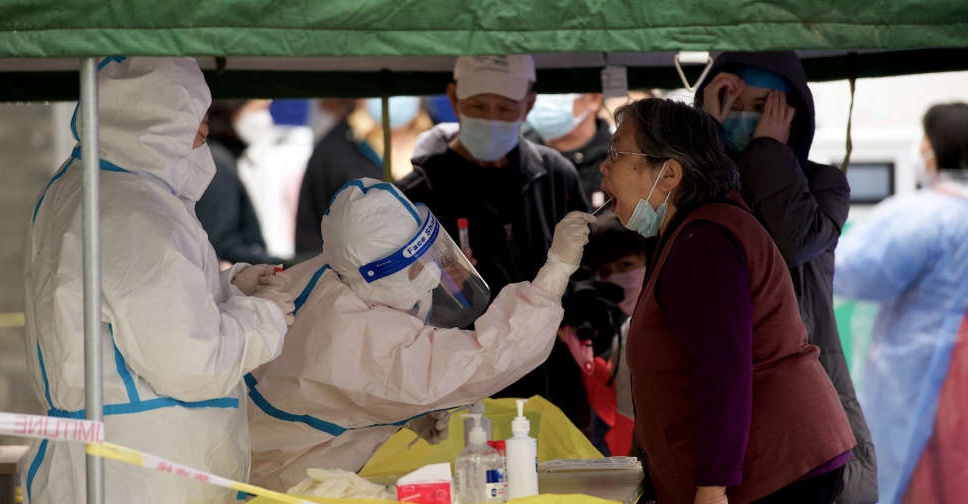
Millions in Beijing's largest district on Wednesday took their second COVID-19 tests this week as the Chinese capital tried to keep an outbreak of dozens from spiralling into a crisis that could force it into a distressing Shanghai-type lockdown.
Evidence the month-long isolation has become unbearable for many of the 25 million people in the Chinese commercial hub is emerging almost on a daily basis on the country's heavily censored internet.
A widely circulated video - since taken down - showed a foreigner trying to break through some metal barriers onto a street, before being pulled back and dragged onto the ground by four people in hazmat suits. Reuters was unable to immediately verify the authenticity of the video.
In Beijing, supermarkets have kept food and other supplies well-stocked under orders from authorities. Local officials also hoped early mass testing would spare them the drama in Shanghai, where officials waited for about a month as cases spiralled before ordering a city-wide screening campaign.
Beijing was testing the more than 3.5 million residents of its Chaoyang district on Wednesday, all of whom were screened on Monday as well. On Tuesday, 16 million from other districts were also tested and are due for another round on Thursday.
In total, 20 million of Beijing's 22 million will be tested three times by the end of the week.
It was unclear what percentage of those tests led to the detection of Beijing's 31 new COVID cases on Tuesday, compared with the previous day's 33. No deaths have been recorded in the capital so far.
As of 8:00 pm on Monday, the results from 526,457 samples from Chaoyang available at the time came in negative. Officials have yet to publish all the results from Monday's test.
MONTH-LONG ISOLATION
Shanghai officials reiterated on Wednesday they would soon begin loosening restrictions in districts that stamped out cases from their communities, without giving a timeframe or other details.
Meanwhile, most people are still either confined to their homes or cannot leave their residential compounds. Even those who can go out have few options, with shops and most other venues closed.
Data showed six of Shanghai's 16 districts had zero cases outside quarantined areas. Numbers for seven other districts were in the single digits. In total, Shanghai detected 171 such cases on Tuesday, down from Monday's 217.
Other cities that have been under lockdown began easing curbs once outside-quarantine cases hit zero.
Shanghai's prolonged isolation has fuelled frustration over lost income, family separation and quarantine conditions, as well as access to healthcare and food. For many, the regular tests present the only chance to open their front doors.
ECONOMIC PAIN
The outbreak has caused severe economic damage to China's most populous city. Shanghai's economy grew 3.1 per cent in the first quarter, lagging the 4.8 per cent growth at national level, and its own 8.1 per cent expansion in 2021.
Hundreds of factories have been allowed to resume operations, mostly with a small number of workers sleeping on site, with state media giving ample air time to the reopening of US carmaker Tesla's plant in Shanghai last week.
But industry bodies say most factories are struggling to produce much as workers remain stuck at home, trucks linger in parking lots, and orders of components from contractors in the same situation are not being fulfilled.
In Shanghai's finance sector, the biggest in mainland China, thousands of bankers, traders and investors are confined to their homes and struggling with basic needs.
Many say they are prepared to move back to other financial centres including Chinese-ruled Hong Kong, where the COVID situation has stabilised somewhat after ripping through the majority of its population earlier in the year.
Shanghai reported 48 new deaths on April 26, down from 52 the day before. That takes the official death toll to 238, all reported from April 17 onwards, although many residents have said relatives or friends died after catching COVID as early as March, casting doubt over the statistics.


 Trump, Greenland, Denmark sign deal in bid to end Arctic standoff
 US F-16 fighter jet crashes in Germany
 Trump urges compete isolation of Iran, expects deal after election
 Trump set for whirlwind UN meetings with wars in Iran, Ukraine on agenda
 Student opens fire outside school in Turkey, 11 pupils wounded